Ah, Convair B-58 Hustler.
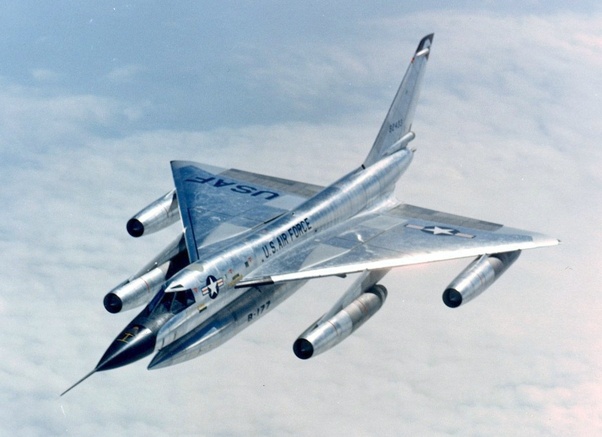
I kinda love that plane
The problem with B-58 is that it could only do one mission well. The Hustler would carry an external nuclear bomb (one at first, up to five later) at high speed, deliver it, then maybe run away while it still could. That was what it could do and while the mission remained relevant, it was an interesting threat to have.
But with better air defences the high speed, high altitude mission became unsurvivable. The Hustler could fly high and fast, but it could still be intercepted by ground-based SAMs. A low altitude mission was still kinda possible for a while, but it was a lot less survivable than what would be required.
Lacking an internal bomb bay there was no way to make the aircraft fly any other type of mission and it was consierably more expensive to operate than the B-52, so it was retired. In truth it was a failed concept to begin with, there are very few successful modern planes that can only do one thing well and are still operational. None of them are bombers, U-2 is one example I can think of, maybe AWACS, but the list drops off very quickly after that. Even airborne tankers can serve as transport planes if needed be.
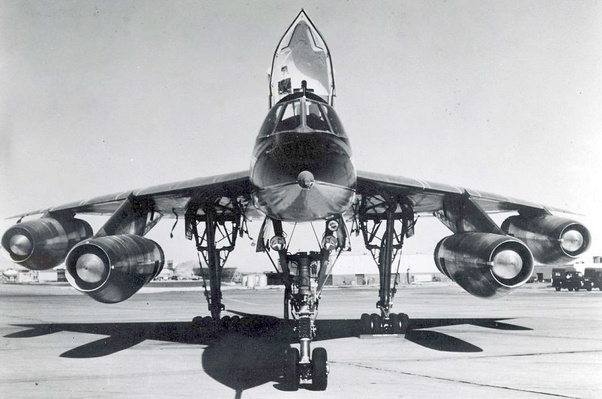
Actually, the Convair B-58 Hustler was the most successful bomber aircraft of its era and its premature withdrawal from service was a serious blunder on the part of the USAF and, especially, Strategic Air Command (SAC). There is a lot of misinformation on the internet about the capabilities of this superb aircraft and its so-called limitations. A few online videos and posts have unfortunately misrepresented the facts behind the premature exile of the B-58 to the boneyard.
Before countering the myths and misinformation associated with the B-58, I wish to reveal the primary source used to buttress key points. Colonel George Holt, Jr. USAF, Retired, is probably the foremost authority on the decision process that resulted in the premature retirement of the B-58.
He was assigned to Future Strategic Forces, Plans Division, on the Air Staff at the Pentagon when SAC made an almost unilateral decision to retire the two existing wings of B-58s in an effort to preserve four wings of elderly and much less capable B-52Cs.
Earlier in his career, he served as a navigator/bombardier and had accumulated considerable operational flying experience on SAC B-47, RB-66, and B-58 bombers. A photo of his book on the B-58 is posted below.
There was no other bomber as capable of conducting the primary nuclear-delivery mission of the B-58 when both the B-58 and the B-52 were in service. With a dash speed of Mach2(+)—two and half times faster than a .45-caliber bullet—and its superior low-level penetration capability combined with an outstanding radar-bombing system and an extremely low-profile radar image, the B-58 was the SAC bomber fleet’s wartime door kicker.
In a nuclear war B-58s would have stuck critical targets long before B-52s penetrated the Soviet Union’s airspace, thereby helping to set conditions necessary for the B-52s to more safely reach their targets.
The B-58’s four J79 engines produced 62,400 pounds of thrust at full power, and with an empty weight of 55,650 pounds, the bomber had an outstanding thrust-to-weight ratio. According to Colonel Holt, “Although [the B-58] was a strategic bomber it could out maneuver, out turn, and out climb most fighter aircraft of the day.
The B-58 had much lower radar, visual, and acoustic signatures than the B-52 and it also had a superior bombing/navigation system. Moreover, the B-58’s ability to fly “silent”with no electromagnetic emissions made it virtually undetectable over enemy territory.
While flying low-level B-58 penetration and bombing profiles during training missions over the United States, per Colonel Holt, no USAF Air Defense Command fighter ever successfully intercepted a B-58. ADC fighters “successfully” intercepted B-58s when the bombers flew at medium-to-high altitudes, but only AFTER the bomber pilots were ordered to deliberately slow down. Similarly, US Army radars associated with air defense missile sites were unable to detect, track, and target the B-58 unless the bomber crew was ordered to emit an electronic signature.
Coming in low and fast over the Soviet Union in wartime, the B-58s would have run silent as they penetrated enemy territory to strike assigned targets. By 1969 a highly accurate radar altimeter was installed allowing the B-58 to fly even lower on its penetration to enemy targets.

The Single Integrated Operational Plan (SIOP) was the general nuclear war plan for Ithe United States from 1961 to 2003. In the 1960s version of the SIOP, one of the metrics used to judge the nuclear capabilities of SAC bombers was the amount of ordnance they were capable of delivering to assigned targets. Per Colonel Holt, in December 1968 the SIOP required SAC to have 932 nuclear weapons loaded on its alert force of B-52s and B-58s.
The contribution of the two B-58 wings was 160 weapons loaded on 32 alert aircraft. (Not every SAC bomber could be kept on alert, which meant the crews were briefed and on standby near their fully loaded bombers—weapons, fuel, countermeasures, etc. Some bombers were always down for maintenance, or flying training missions, or being used to support developmental tactics and weapons tests.)
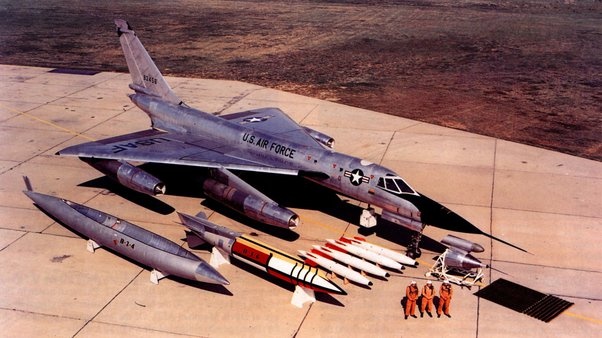
The wartime payload of each B-58 was one nine-megaton bomb in the centerline pod and two one-megaton bombs under each wing. Therefore, each B-58 on alert would have been armed with five thermonuclear bombs. Before the first B-58 wing was deemed fully combat ready, a crew demonstrated the superior bombing accuracy of this aircraft’s systems in comparison to other SAC bombers when it took first place at the 1960 SAC Bombing Competition.
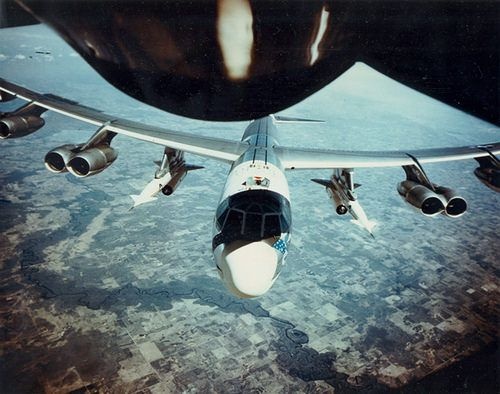
Whereas the SIOP assigned the much larger B-52 fleet (and until 1965 the B-47 and B-52 fleets) the preponderance of the bomber-delivered nuclear ordnance—772 thermonuclear warheads—each B-58 during the 1960s was actually armed with more nuclear weapons in comparison to the B-52. A B-52′s SIOP payload in the 1960s was usually either four nuclear bombs or two nuclear AGM-28 Hound Dog stand-off missiles. FYI, the SIOP typically assigned air defense targets to those B-52s armed with Hound Dog missiles.
Below: A B-52 armed with its wartime load of two AGM-28 Hound Dog missiles approaches a tanker.
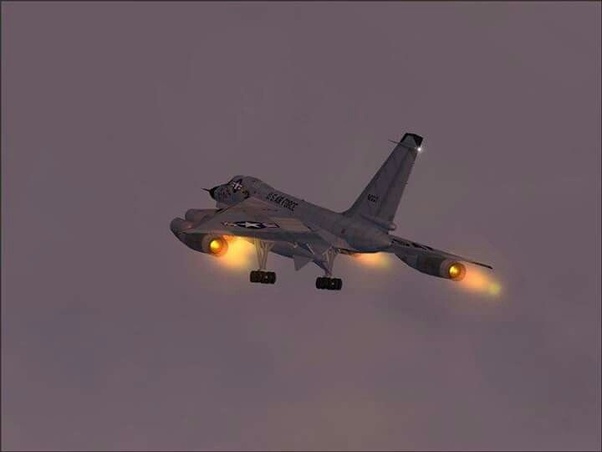
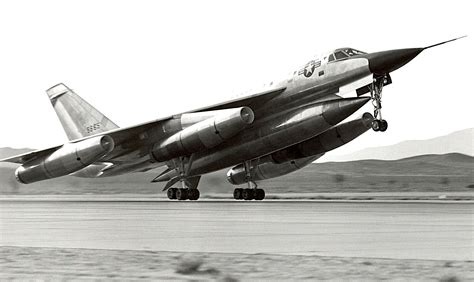
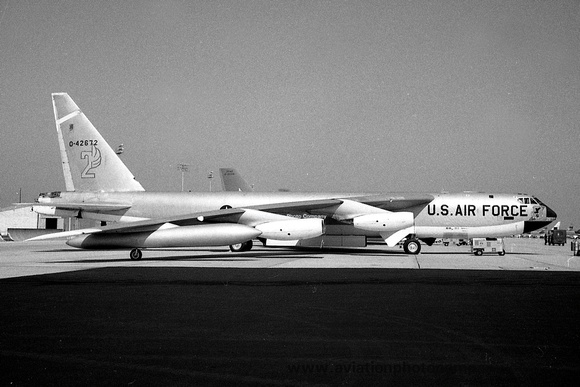
Above: B-58 takeoff.
Per Colonel Holt, in the event of a Soviet nuclear first strike, the B-58s assigned to the alert force stood a greater chance of survival than alert force B-52s. The B-58s could launch faster than the B-52s and exit the vicinity of their airfields on afterburners before probable nuclear air bursts destroyed the bomber bases and detonated in the immediate surrounding areas in an attempt to destroy in-flight bombers. Alert force B-58s had a 100-percent chance of a successful launch, but up to 30 percent of the slower alert force B-52s might have been destroyed on the ground or shortly after takeoff. The reason SAC reduced the size of its B-52 wings to a normal complement of 15 aircraft, and spread its wings to so many bases, was it took about twice as long for a B-52 to get off the ground as it did for a B-58. Therefore, dispersal was more critical for the survival of B-52s than it was for B-58s, which were concentrated in just two wings, each with 39 aircraft.
Moreover, the B-58s were assigned tougher targets in terms of penetrating enemy air defenses. The SIOP anticipated that the slower B-52s would begin penetrating Soviet airspace after a combination of B-58, SLBM, and ICBM strikes had degraded enemy radars, SAM sites, and fighter bases.
Here are some myths associated with the premature phase out of the B-58 force.
- Myth: The B-58 had a high accident rate. Per Colonel Holt, “Compared to other aircraft, the “operational”[B-58] accident rate was not that bad and quite different from the oft-quoted phrase, ‘Of the 116 built, 26 were destroyed for an accident rate of 22 percent.’” In truth, 116 B-58s were produced and 22 were lost in accidents, but seven of the B-58 losses were developmental versions of the aircraft that crashed during flight test and evaluation sorties before this bomber became operational. Eleven Convair test pilots and crewmembers were killed during the testing and evaluation phase of this extremely sophisticated aircraft. Lessons learned from these crashes ultimately led to B-58 design enhancements. So, 19 B-58s were lost after the bomber became operational and they were being flown by SAC crews.
- Two of the 19 B-58s were lost in taxiing accidents. One of these B-58s was a total loss, but the other aircraft was eventually repaired and returned to operational service.
- Of the remaining 18 aircraft, two were lost at Paris Air Shows—one was performing a aerobatic maneuver that over-stressed the air frame and the other B-58 impacted the ground after flying too low.
- Thus, 15 B-58s were lost while flying operational missions over a span of 10 years, which translates into an average aircraft loss rate of 1.5 per year. In comparison, the B-47 bomber force experienced 28 fatal accidents and 63 deaths in just one year.
- Myth: The B-58’s planned production run was reduced because of the high cost per unit, a small payload, a mission profile different from the design concept, and, in the 1960’s a Secretary of Defense that downplayed the role of the bomber. Yes, Secretary of Defense McNamara—and the next two successors—consistently downplayed the role of the bomber. He greatly preferred ICBM and SLBM systems over bombers, particularly after it became clear that the pending advent of MIRV warheads would soon greatly increase the nuclear firepower of these missile systems. R&D costs expended to produce an item, whether it be a Barbie doll or a supersonic B-58 bomber, are sunk costs. The total unit cost of the B-58 appeared high because the US Air Force cut the planned B-58 purchase in half due to budget constraints. A similar fate would await the B-2 bomber in the 1990s when only 22 bombers were produced instead of the 132 originally planned. As for the B-58′s “small payload,” during the 1960s it actually carried more nuclear weapons than the B-52.
- Myth: Originally intended to fly at high altitudes and high speeds to avoid Soviet fighters, the introduction of highly accurate Soviet surface-to-air missile (SAM) systems forced the B-58 into a low-level penetration role that severely limited its range and strategic value.
- Soviet SAM systems forced all SAC bombers—B-47, B-52, and the B-58—into a low-level penetration role. However, the B-58 quickly adapted and excelled at low-level mission profiles. Indeed, before the B-58 entered operational service, Convair test and evaluation crews demonstrated this aircraft’s excellent low-level penetration capabilities. One four-hour mission in September 1959 included a two-hour flight at .92 Mach (700 mph) at 500 feet or less above ground level (AGL). One portion was as low as 200 feet AGL. The low-level route started at Carswell AFB Texas and ended with a simulated bomb attack on Edwards AFB in California. During the debriefing, the crew reported it had experienced a smooth ride despite turbulence. The aircraft’s delta wing with its low aspect ratio and strength was uniquely adapted for low-level, high-speed flight.
- During operational service, the B-58 repeatedly demonstrated that it had sufficient range to strike assigned SIOP targets. Per Colonel Holt, the strategic value of the B-58 actually increased when forced into the low-level penetration mode, because its speed, low radar signature, and its ability to fly silent made it virtually undetectable by enemy radars.
- In contrast, during low-level flight profiles, the B-52 was much slower than the B-58. Per Colonel Holt, at low-level the B-52s flown in the 1960s had restrictions on their bank angles and speeds above 325 knots IAS. The USAF Studies and Analysis Directorate at the Pentagon ran computer simulations comparing the B-58 to the B-52. This directorate concluded that the B-58′s speed advantage and its very low radar signature gave the B-58 a higher probability of evading detection by Soviet radars. This held true even when the B-58 was programmed to fly at a higher altitude than the B-52 during low-level penetration to the target. One of the evaluators stated: “The difference between the B-58 and the B-52 was like comparing a postage stamp to a barn door.”
- All three SAC bombers—B-47, B-52, and B-58—started showing signs of structural fatigue after numerous hours of low-level flying. In 1967 all B-58s underwent extensive inspection and repair of all primary and secondary structures to correct this problem.
- B-52 bombers also underwent extensive structural modification and repairs to the airframe to help mitigate the effects of turbulence on the airframe. Indeed, the B-52 fleet initially struggled during its transition to low-level penetration profiles and a few bombers and crews were lost during low-level missions over the United States. Below: Crash site of a B-52C lost on 24 January 1963 after its horizontal stabilizer separated from the aircraft due to heavy low-altitude turbulence.

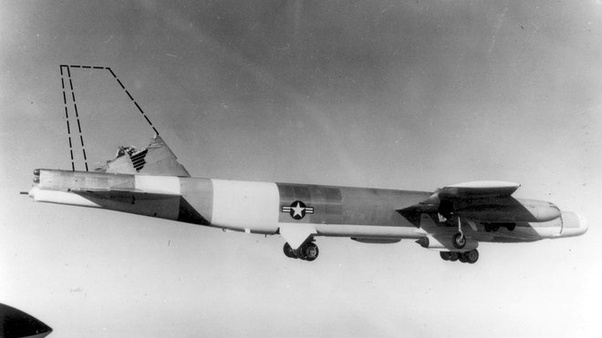
Below: Another B-52 lost its horizontal stabilizer at an altitude of 14,000 feet due to heavy turbulence on 10 January 1964. Lessons learned from these and other B-52 turbulence-related accidents led to modifications to strengthen the horizontal stabilizers on the B-52 fleet. In contrast the B-58’s strong delta wing and short profile made it relatively immune from the oscillation effects of low-level turbulence experienced by B-52 crews.
4. Myth: The B-58 cost three times as much to operate as the B-52. Per Colonel Holt, a former Top-Secret Report, now declassified, on the annual operating costs of SAC bombers, including the associated cost for KC-135 tanker refueling for both the B-58 and the B-52, shows that the B-58 was less costly to operate on an airplane-to-airplane basis than the B-52. For anyone interested in the cost estimates, this report stated that the estimated annual costs of operating a B-58 was $1.21 million in comparison to $1.42 million per B-52. It is true that a B-58 bomber wing was more expensive to operate than a B-52 wing, but this was because SAC assigned 39 B-58s to both of the B-58 wings, whereas only 15 B-52s were assigned to each B-52 wing.
Below: B-52C
So, what caused the premature retirement of the B-58? The B-58 was fully funded to remain in the SAC bomber inventory until 1974. However, at the height of the Vietnam War, and during a period of severe budget restrictions, SAC in 1969 made a fateful decision to retain four B-52C wings that were on the chopping block instead of retiring these nearly obsolescent aircraft. In turn, SAC recommended the early retirement of the two B-58 wings to free up sufficient funds to maintain four mostly B-52C wings on operational service. Per Colonel Holt, SAC was supposed to make its force recommendations through the Plans Directorate at The Pentagon. However, on this occasion, SAC bypassed the Plans Directorate and submitted its recommendations directly to the Operations side of the house—a most unusual move. Colonel Holt assesses that SAC was reluctant to lose four wing commander positions, so it opted to lose two instead—both of the B-58 wing commanders and their aircraft. Unfortunately, the Chief of Staff of the Air Force, General Ryan agreed with the SAC position, mostly because he was reluctant to oppose the recommendations of the Commander-in-Chief of SAC. General Ryan briefed the Secretary of Defense who agreed to the early retirement of the B-58. In any event, SAC was successful in relegating its most capable strategic bomber to the boneyard, but the fallout from the decision to trade 78 very capable B-58s to retain 60 nearly obsolescent early model B-52s would have consequences.
a. SAC failed to mention to General Ryan the impact the early removal of the B-58 fleet would have on the SIOP. With the B-58s factored out of SIOP calculations, along with the 429 megatons of nuclear ordnance the B-58 alert force was assigned, a very angry General Ryan suddenly had reasons for concern. Much of the B-52D force was supporting the Vietnam war effort in a conventional, high altitude, bombing role. Moreover, the B-47 had already been retired from operational service and the FB-111 would not start supporting the SIOP until 1971 at the earliest.
b. On top of this bad decision, SAC had to retire its four wings of B-52Cs anyway.
c. Whereas SAC had a SIOP commitment to maintain 170 B-52s on alert, SAC could only maintain about 150 aircraft on alert. The sudden loss of the B-58 fleet is probably one of the reasons the US rushed MIRV ICBM and SLBM systems into service.
In any event, the decision to prematurely retire SAC’s most capable bomber, probably a bureaucratic device to maintain force structure, was an unforced error.