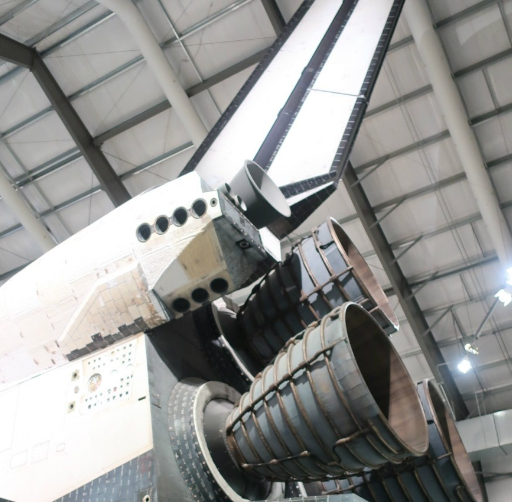
Because, among other reasons, it would not have significantly expanded the station’s usable volume, but it would have significantly increased its mass—and therefore the amount of propellant needed to periodically boost it.
The shuttle’s crew cabin’s total pressurized volume was 74.3 cubic meters (2,625 cubic feet), while the ISS has a pressurized volume of 931.57 cubic meters (32,898 cu ft), so for the cost of a permanently occupied docking hatch, a shuttle would have increased usable space by a little under 8%. Granted, that includes a space galley, toilet, and living quarters, but much of the rest of the gear would be dead weight.
Speaking of weight, a shuttle orbiter has a dry mass of 171,000 pounds (77,564 kg) compared to the ISS at 919,965 pounds (417,289 kg).
So, the shuttle would have increased the ISS volume by 8% and its mass by nearly 20%. The shuttle main engines remain of not-inconsiderable value, and there are numerous parts of the shuttle interior that would become a maintenance burden after extended time in space—if not a danger to the crew, since the shuttle was never designed for continuous in-space servicing.
In the long run, the shuttle would have been a drain on ISS operations.
But as it is now, the shuttles are serving as repositories for spare parts for the ISS. Shortly before I visited Endeavor last spring in LA, NASA came by to harvest some expensive titanium storage tanks from it, for transport up to the station.
Meanwhile you’ve increased the mass of the ISS by nearly 170 tons, most of which is utterly useless to you. But you still have to use reaction mass to keep it in orbit (the ISS is low enough they need to fire retros occasionally to make up for lost height due to the tiny amount of air friction it experiences).
Also, life support, power, indeed everything in that shuttle cabin is designed to be used in space maybe a month at most. It’s not designed for long term usage. And it’s not like you can just plug it in to the ISS – no plugs…on either side.
Basically, it’d be like attaching a semi truck and trailer to your house so you could use just the cab space as a spare room (the trailers filled with toxic waste or something)…then tried to run the “room’s” lights and heat off of the truck’s engine, with very little fuel in the tank and no way to get more. And all the while, the property tax accessor treats your tax rate as if the entire truck and trailer were usable house space.