Well, for one thing…Alaska is not as “big” as you (people from the US) seem to think. Alaska has an area of about 1.723 million km². Meanwhile, Canada has an area of about 9.98 million km², or almost 6 times the area of Alaska. Alaska’s population is roughly 740 thousand people, whilst Canada’s population is around 41 million, or about 50 times the population of Alaska.
But wait…the question is about lumber.
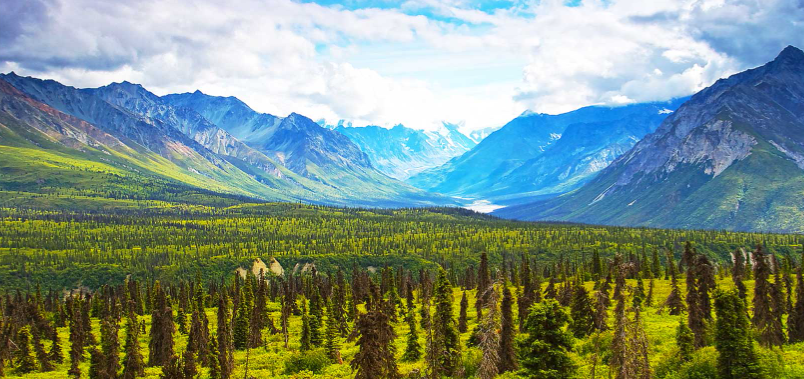
Well, about 26% of Alaska is covered in forest, that is about 450,000 km². Canada, on the otherhand has forest covering about 40% of the land, or about 3,992,000 km². Canada has more than 8 times as much forest compared to Alaska.
Sooo…even if Alaska expanded their lumber industry, it would not be capable of coming anywhere close to what Canada’s lumber industry is capable of producing!
Sure, the rest of the US has a large covering of forest, although less than Canada. But, as we all know, trees grown in colder climates make better lumber…which is why Canadian lumber accounts for 50-70% of US lumber imports.
Now, the orange buffoon in the Oval Office has slammed tariffs on Canadian lumber, but this will hurt the US as construction companies will either have to rely on poorer quality “American” lumber, or pay the ridiculous 40% increase in the cost of Canadian lumber. Canada, meanwhile is busy seeking trade with the rest of the world.
Whilst the US “needs” Canadian lumber, Canada does not “need” to sell our lumber to the US.
Theoretically, Alaska could grow the size its forests and its population and its industrial & transportation infrastructures, to the point where it could sustainably replace Canadian lumber imports. This would take time, focus, and concerted effort. In the meanwhile, you would be paying the extra cost of tariffs.
As the Alaskan lumber came online, it would have to travel the much greater distance to its US destination, greatly adding to its final cost. Also, Alaskan goods transshipped through Canada to the US are currently bonded, which means that they are sealed and do not officially enter the canadian economy or attract customs duties and tariffs.
If a future Canadian government was as capricious as the current US administration, they could change that and impose extra tariffs, duties, handling fees, road taxes, etc, at will. The only way to avoid those costs would be to transport the lumber by sea to the West coast of the US and then by truck or rail to its final destination.
This would require further development and add even more to the price tag. How all this affects the US economy, I can’t say, but I doubt that Trump has thought any of this through.
Sure, let’s just destroy all of Alaska’s natural lands by disregarding all environmental concerns and simply turn the state into a giant lumber farm.
Aside from only a small percentage of Alaska’s land being suitable for the lumber industry, much of the territory that could be cultivated is ecologically fragile and to increase its use in such a way would destroy the environment.
And then, of course there is the cost of harvesting and transporting the lumber from Alaska, through Canada to the US. And Canada has no reason not to charge as much as they want to allow the US to transport the timber across Canada into the US.
Perhaps a more intelligent response would be to get rid of the brain damaged, dementia ridden moron in charge of destroying our international trade and relationships with our former allies.