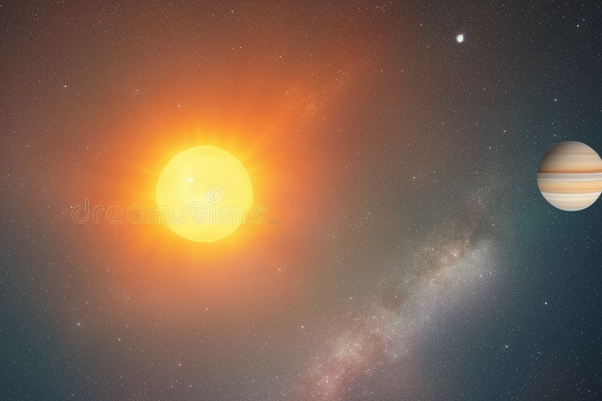
A star is headed our way, and it’s called Gliese 710. Gliese 710 is a star located 64 light-years away in the constellation Serpens, which is predicted to pass through our hypothetical Oort Cloud in approximately 1.3 million years.
I called it “hypothetical” because we don’t know if the Oort Cloud exists, but we believe it does based on the trajectory of various long term comets. The Oort Cloud is a “cloud” thought to consist of icy objects that surround the Solar System at a distance of up to 100,000 AU, or 1.58 light years. This is over a third of the way to the nearest star and its exoplanet, Proxima b, at 37.3%.
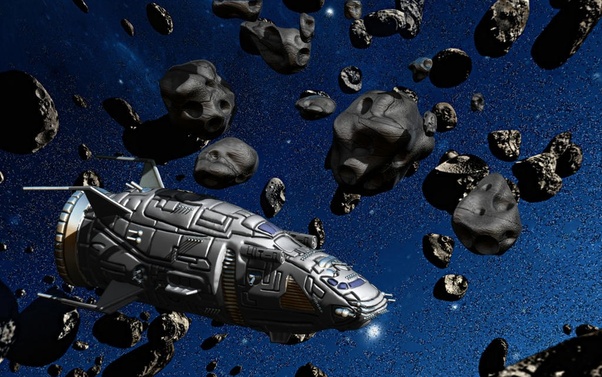
I say “cloud” in quotation marks because what Hollywood depicts as an asteroid belt or the Oort Cloud is not what’s really out there. For example, in some films, entering the Oort Cloud or the Asteroid Belt means risking constant danger of being crushed by massive rocks that are crashing into each other. But in reality, the vast majority of space debris is spread out over incredible distances, and collisions don’t happen very often. Navigating through an asteroid belt or Oort Cloud isn’t a constant battle for survival as often portrayed by Hollywood’s special effects technology.
Quora user Adam Wu said, in the comment section below, “For context, the hypothesized average distance between two objects in the Oort Cloud is only a little bit smaller than the distance between Earth and Venus at the closest pass.”
But I digress. They pretty much accept the Oort cloud is there, but it’s hard to prove since objects in the Oort cloud are more than a light year away, thousands of times further than Voyager 1. It will take about 300 years for Voyager 1 to reach the inner edge of the Oort Cloud and possibly about 30,000 years to fly beyond it. Gliese 710 will have plenty of room to pass by about 2.39 light years from Earth, far too distant for a small star to disrupt the orbits of the planets around the Sun, but close enough to fling some space rocks our way.
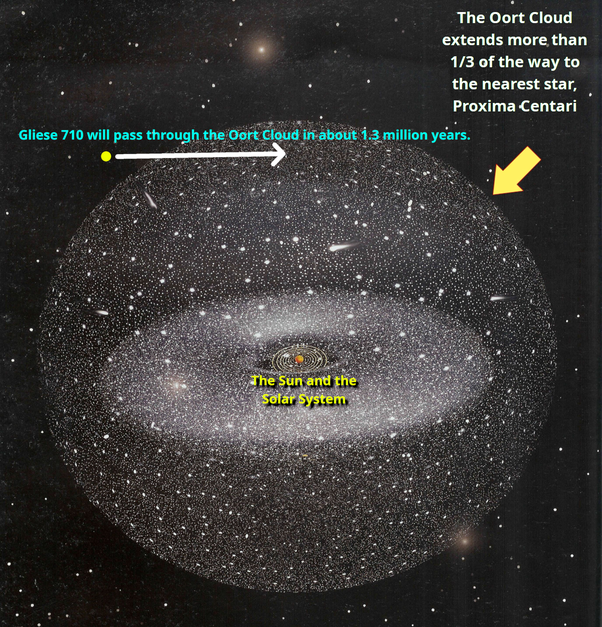
Scientists keep an eye on Gliese 710 and try to predict its potential effects on the Oort Cloud. One way they do this is to simulate the trajectory of Gliese 710 and its potential interactions with the Oort Cloud using computer models. Another way, of course, is for scientists to use powerful telescopes to search for objects that may have been perturbed by Gliese 710. This might help us predict what effect the star will have when it eventually passes through our Oort cloud.
It is currently unknown whether Gliese 710 has an Oort cloud of its own. However, if it does have an Oort cloud, it is possible that it could interact with our solar system’s Oort cloud during its passage, potentially leading to a merger of the two clouds. This could result in an increase in the number of comets entering the inner solar system. I was unable to find any more information about this potential merger of two Oort clouds. The existence of Oort clouds around other stars has been inferred based on indirect observations, such as the detection of excess infrared radiation or the presence of comet-like objects in the vicinity of a star. For example, observations of the star Beta Pictoris have revealed the presence of dusty debris disks and comets that may be the result of interactions with a hypothetical Oort cloud.
As far as I know, there’s currently no evidence to suggest that Gliese 710 has any exoplanets. But, just because we haven’t seen exoplanets around this star, it’s possible that there could be planets around Gliese 710 that are too small or too distant from the star to be seen from here. If there are any exoplanets, it’s not thought that any of them would be habitable.
This isn’t a bright star. It’s got what they call an “apparent visual magnitude” of around 9.7. With these numbers, the smaller the number the brighter the star. Under ideal conditions, the human eye can only see stars with a magnitude 6 or 7, so you can’t see Gliese 710 with the naked eye. Naturally, as it heads in our direction, we expect it to get brighter, but, unlike our planet Venus, it is not expected to become bright enough to be seen during the daytime, even at its closest approach to the solar system.
This should serve as evidence that a star this far away and this small isn’t going to disturb the planets orbiting our much larger Sun.
The slow passing of Gliese 710 will mostly go unnoticed by anyone living on the surface of Earth at the time. Set your calendar to remind you to go out and spot it with a telescope, 1.3 million years from now.