
There are several theories explaining this baffling bit. I will share what I learned at the University.
Our professor has some merit… He said, there is more than an “Interpretive Art” reason for David’s modest bits being rather… dainty, as it were. It is called Perspective.
The sculptor knew that you (the viewer) would be on the floor, looking up at David, an awe-inspiring free-standing colossus one could walk around. David the giant-killer is himself 5.17-metre (17 ft 0 in) tall!
Now, when you stand close to a skyscraper or tower, have you noticed how the tower seems to get narrower the higher it goes?
Well, our sculptor (you know who he is by now) realized that his statue would suffer the same problem, unless he compensated for it. In short, David would have a teensy, weensy head, and a ginormous Endowment of the Arts.
Working this out rather cleverly, Mickey the Angel adjusted All of David’s heroic proportions backwards. Not only are his special dinners undersized, his head, and his hands are intentionally HUGE too, in order to thwart the natural illusion of what is called “Three-point perspective”.
The ‘vanishing point’ disappears up and beyond David’s head. This bit of theory can get kind of hairy, but there’s a great little intro article on creating 3 Dimensional Illusions in the link— artists will really appreciate it, but anyone can learn it. In fact, with a friend, try this experiment yourself— stand in a stately pose, and have your friend take a ‘selfie’ of you, from the floor, looking UP. Doesn’t your head look little bitty, and your feet and hands huge? (We’ll leave it up to you if you want to be a performance ‘life model’, though!)
That’s one theory. Do you think my professor had a— point?
Look not just at the parts you asked about, but the size of his enormous cranium.
But from this angle, notice how his head does not seem as outsize as it did before. He looks completely in proportion.
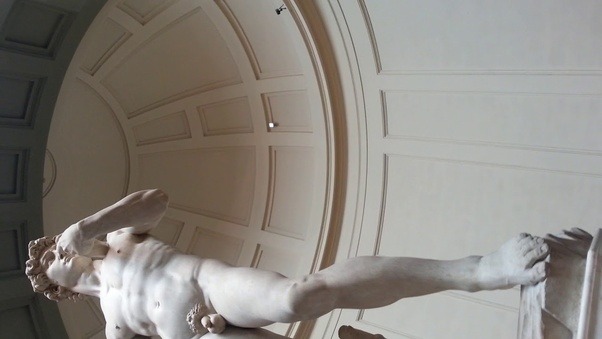
That Michelangelo was pretty good!
The explanation is somewhat lengthy, and follows.
Greek and Roman art, especially Greek, always portrayed men’s “bits” as quite small. This was philosophical in origin. The Greeks believed that thought and the rational part of human existence was far superior to the bodily elements, controlling self-control and justice. The physical was deemed completely secondary (this despite the fact that they began the Olympic games). Their heroic sculptures always followed the model described by Aristophanes in The Clouds, written around 420 BCE. Aristophanes says the perfect man has “a gleaming chest, bright skin, broad shoulders, tiny tongue, strong buttocks, and a little prick.”
Only figures that were seen as barbaric, animalistic, Egyptian (!) or brutish, like the figure of Priapus, the god of Lust, were portrayed with large members. Prepubescent boys were a Greek ideal (also sought out sexually), and hence often used as an artistic model for the perfect male form.
Medieval art carried on this tradition, and so did most of Renaissance art, including that of Michelangelo – although it has been said by some that Michelangelo slightly relaxed the standard. However, this is really a judgment call, I would say.
In any case, this is what some might call the “below the belt history of manly art.”