First of all. There is no “tariff war”. There is an ongoing attempt to bully Canada by an overconfident innumerate pedophile rapist felon who is the laughingstock of the world. This bully has been handed his cheeto orange ass by savvy, intelligent Canadian PM MARK CARNEY, at every meeting.
This will not change.
Canada has handed Reichmeister Tangerine his floppy cheeto ass at every meeting. Trump absolutely will resort to rage and violence. He will fuck that up also.
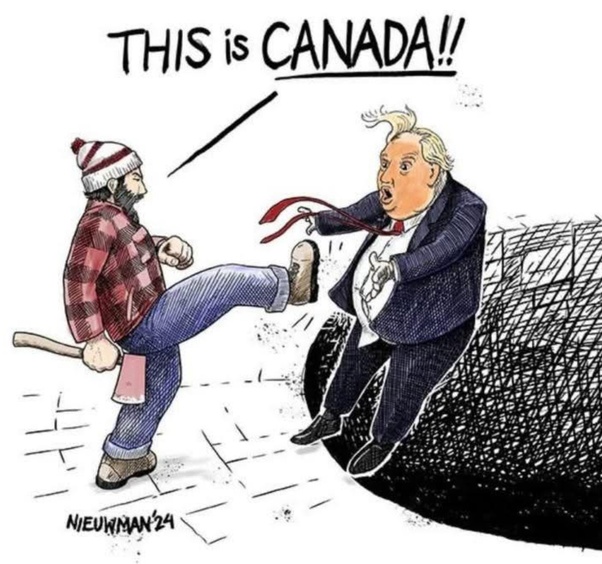
When Trump announced that he was going to (trade) war with his northern neighbour, he spoke about the iniquities of the horrible trade deal that somebody had tricked the US into signing called (in the USA) the USMCA. He pointed out that it included horrendous tariffs on some American agricultural products…forgetting if course that this was what he called one of the greatest trade deals ever when he personally signed it during his first administration.
After some bluster and a few TACO moves he announced to great fanfare what the new tariffs would be on Canadian goods entering the USA.
So what’s the confession, Sam?
I confess that I missed the bit where his announced tariffs do not apply to goods and services covered by the USMCA. This major omission is huge – the USMCA covers about 80% of all Canadian exports to the USA.
Now, I am still not completely clear if this means that USMCA goods are not effected by any of the new tariffs. I asked my AI copilot for clarification and the answer was along the lines of “well that depends on whether any part of the good or services is counted under the new tariffs…”
So, I am open to correction – please chime in if you understand the current situation any better.
Regardless of the above, what I do know is
- If tariff income is rising in the USA, then imports from countries such as Canada must be continuing.
- This tariff income is paid by the importer. For example say an American importer buys an item from Canada for a unit cost of $1,000. That is what they pay to the Canadian exporter. If a tariff of 25% is imposed, the US importer must also pay $250 to the US government. Thus the total price to the American consumer would be $1,250 plus whatever markup the importer decides to add.
- Obviously, the $250 tariff paid in the example above is a tax on the importer. It doesn’t matter how many times Bessent,Trump and Nutlick claim otherwise, this is an undeniable fact and has recently been confirmed by a court of appeals in the USA.
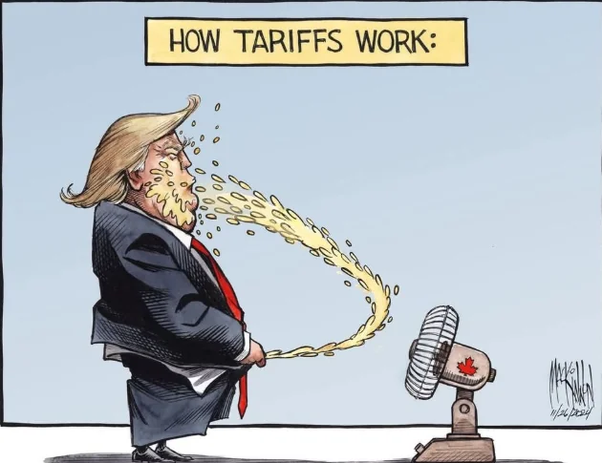
- The Trump regime also like to “muddy the water” by claiming that it is the exporter (Canada) who is paying the tariffs. This is false. Let’s revisit the example above. Say the importer tells the Canadian exporter that because of the tariffs, the goods have become too expensive for them to sell and they request a price reduction by the exporter. In order for them to completely counteract the US tariff, they would need to drop the price from $1,000 to $800. But this means that the Canadian exporter will be selling at a loss and obviously that is not sustainable. Clearly the situation is bad for both exporter and importer and most of all for the American consumer.
- Some minor price adjustments may take place by importer and exporter, but the net result is that there will be less trade but goods and services will be more expensive in the USA.
So, who is winning?
The answer remains the same as always. There are NO WINNERS, ONLY LOSERS in a trade war such has been started by Trump.
Of course since Trump has been such a loser all his life, he has honed the ability to portray failure as victory to a very fine art, and he will no doubt continue to claim his loss as a win.
For those who are curious to know if I would ever support a tariff policy, the answer is Yes. But only in the the following situations
- The tariff is surgical in nature. I.e. on a well defined product or group of products. Example: pickup trucks
- The target export country has a pernicious trade practice related to the product that is damaging to domestic production. Example: Russia is trying to export trucks at a price below the cost of production.
- The practice in point 2 has continued despite threats of retaliation.
- The tariff size is commensurate with the problem.
- The imposition of the tariff is done through legal means.
Final words. Tariffs, though simple in principle, can lead to complicated consequences. This is probably why they have been used somewhat sparingly by the US who until recently had followed a policy of free (and fair) trade for almost a hundred years. It is educational to look at the result the last time a blanket tariff policy was pursued.