
Knowledge

If the Earth were a grain of sand, then how big would the rest of the universe be in comparison?

Let’s make earth be a largish grain of sand, about 1.27 mm in diameter. This gives us a scale of 10^10 or ten billion to one. Fairly easy to make calculations this way.

All in this scale:

  1. Distance to the moon: 40 mm, about 1.6 inches
  2. Distance to the sun (1 AU): 15 meters or about 50 feet.
  3. Distance to Jupiter: 78 m.
  4. Distance to Pluto: 600 m.
  5. One light year (9.5 trillion km): 950 km. BTW, this means light moves at 0.03 m/s.
  6. Distance to nearest star (4.22 LY): 4000 km.
  7. Distance to galactic center (26,000 LY): 25 million km.
  8. Distance to Andromeda galaxy (2.54 million LY): 2.4 billion km (but at this scale, still within our real-world solar system).
  9. Distance to the center of our Virgo supercluster (about 65 million LY): 60 billion km (deep in the Oort Cloud, in the real universe). There are probably 10 million superclusters in the observable universe, so we are still a big step away from the size!
  10. Distance to the edge of the observable universe (94 billion LY): 90 trillion km, almost 10 LY in the real universe.

So scaling the earth to a grain of sand, Pluto is a 10 minute walk, local stars are a plane flight away, our local group of galaxies fits in the solar system, but the edge of the universe is way past the nearest star! A freaking big place!

Edit — just for fun: Bryan Harris asked about sizes (rather than distances) in this scale:

11. Size of Jupiter: 14.3 mm (a large marble).

12. Size of HAT-P-35b (largest accurately measured exoplanet): 50–70 mm (a tennis ball).

14. Size of the sun: 139 mm (a grapefruit).

15. Size of Betelgeuse (well-known hypergiant star): 125 +/- 25 meters (a large blimp). A few hyper giants are half again as big, and in this scale, would fill a large stadium!

Related Posts

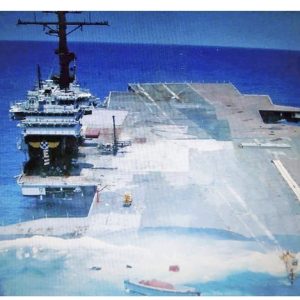
Why was the aircraft carrier USS America CV-66 almost impossible to sink when it was used as a test target in 2005 while battleships with much thicker armor were routinely sunk in combat in WW2 using now-obsolete weapons?

The USS America is the only super carrier ever sunk, either on purpose or in combat. It took four weeks and they ended up having to scuttle her…

Are there dead bodies in Titanic?

There are some preserved bodies inside the bowels of the wreckage. The engineers that were trapped in the bottom are believed to had been preserved as they’re buried…

Can China destroy the American Navy fleet if they get into Chinese waters?

China can destroy any fleet anywhere in the world. Not only an American one. Not only near and around China, but anywhere. The idea that China has the…

Is it true that USS Eisenhower (docked for repairs in Souda Bay) hit and severely damaged by multiple Houthi ballistic missiles?

Yes, the Eisenhower was sunk. Fortunately close NATO ally the United Kingdom stepped in to help – you see the Argentines managed to sink HMS Invincible three times…

If a planet is 500 light years away, does that mean that even if you traveled at the speed of light, it would still take you 500 years to get there?

In Special Relativity, we are concerned with different frames and how they compare with each other. So the short answer is you could do it in under 500…

How did the US transport hundreds of fighter planes to Europe during WWII? Did they have the range to fly that far?

In 1942, as the British readied airfields for them, B-17 bombers and P-38 twin engine fighters would self deploy from the US to England. Neither aircraft had the…

error: Content is protected !!