
In Special Relativity, we are concerned with different frames and how they compare with each other. So the short answer is you could do it in under 500 years, depending on which frame the 500 years is counted in.
Let’s suppose that Ken is on Earth and Barbie is on Kepler-186f, which is just 500 light years away:

Ken has a date with Barbie in one week based on Earth and Kepler-186f time. Since these planets are not moving very fast away from or toward one another, they are virtually in the same reference frame: time moves nearly the same for matter on both planets.
So Ken begins his journey traveling at 99.99999995% of the speed of light. According to Ken’s clock, he arrives to Kepler-186f in 5 days and 18.5~ hours – a day early, right? Quite literally only a little under 6 days have passed for him. However, when Ken arrives, Barbie has long since given up on Ken, married her fitness trainer, had kids and been buried. RIP Barbie. Let’s just hope our half-millennia-old Ken can find another suitable partner in the Cygnus system.
The moral of the story is to bring your loved ones with you if you discover some way of traveling in close proximity to the speed of light and decide to embark on an intergalactic journey. Alternatively, if they had some kind of instant communication (which is impossible based on our current understanding of physics), Ken and Barbie could have agreed to both travel at the same speed and meet at a planet halfway between.
The Case of Muons and Special Relativity
I’d like to bring your attention to the curious case of muons. When a cosmic ray collides into the outer atmosphere, a muon gets produced. This then hurtles at around 0.98c toward the surface of Earth.
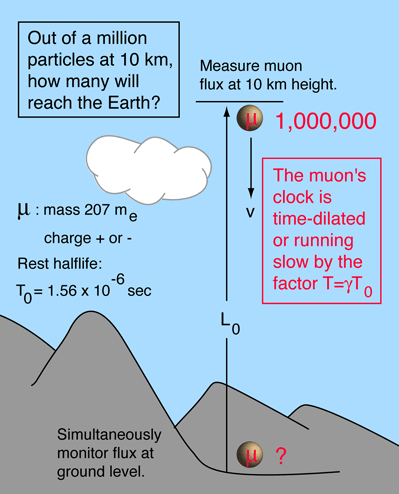
Given the rate at which muons decay and the distance to the surface, only 3 out of 10 million should touch the ground. But the actual amount that reach the surface is more like 490,000 out of 10 million. This completely baffled scientists. That is until someone applied Special Relativity!
tM=tE√1−(0.98cc)2
tM=0.199tE
When you account for the time dilation due to the velocity they are traveling, the Muons only experience 1/5th of the time that we measure while they travel from the atmosphere to the surface.
Likewise, Ken, traveling much closer to c, reaches the Cygnus system with under a week worth of time passing for him during the trip. However, Earth and Kepler 186f simultaneously clocked a little over 500 years during Ken’s trip. As such, Barbie has long since been buried when Ken arrives. And Ken will probably be feeling a little like Captain America awaking out of his sleep to find technology has gone forward a few centuries.
No – it means that, travelling at (or shall we say, exceedingly close to) the speed of light, someone on earth would observe you completing your journey in (a little over) 500 years*. For you yourself, the journey time would be much shorter – the closer to the speed of light you travelled, the closer your journey time would approach zero.
Travelling at 0.999998c would make the journey time just one year for you. Travelling at exactly the speed of light (disregarding for now the physical impossibility of this) would make the journey time instantaneous for you, but still 500 years for someone observing you from earth.
* I’m assuming here that:
a planet 500 light years away
means that someone at rest on earth would measure the planet to be 500 light years away; and by:
observe you completing your journey in 500 years
I mean that that an observer on earth would receive a light signal sent by you, at the moment of your arrival at the planet, after ~1000 years had elapsed (on their clock) following your departure from earth; knowing the light travel time from the planet to earth is (for them) 500 years, the earth observer could then infer that you arrived at the planet ~500 years after you departed (again by their clock).
Many of the comments suggest that the travel time measured by the traveller must be 500 years by the very definition of velocity, using an argument along the lines of:
a light year is the distance light travels in one year, so something travelling close to the speed of light takes ~500 years to travel 500 light years, duh!
This equates the original question to a question like this one:
if I travel at 30mph along a straight road to a destination 30 miles away will it take me one hour to get there?
The answer to this is obviously ‘yes’ but the questions are not equivalent (at least in how I interpret the question). The reason they are not equivalent is that when you consider objects approaching the speed of light, new physical effects come in to play which are not present (or at least not significant) at lower speeds.
The confusion/disagreement is I think really one of language, not physics. It centres around the question ‘who measures the distance to the planet to be 500 light years?’. There are two possibilities that the wording of the question might allow:
- The 500 light years distance is measured by someone at rest on earth. In this case, if that person steps in a spacecraft and immediately accelerates towards the planet to a velocity of 0.999998c, and measures the distance to the planet again, they will find the distance to be only 1 light year, and they will arrive at the planet after 1 year of travel by their onboard clocks (mechanical, atomic and biological).
- The 500 light years distance is measured by someone on the spacecraft which is already travelling at close to the speed of light towards the planet. In this case the travel time to the planet measured by the onboard clocks will indeed be 500 years (by the very definition of velocity in the way many comments have pointed out). What may be less obvious in this case is that, if the spacecraft were travelling towards the planet at 0.999998c when the traveller on board made this 500 light year distance measurement, it would imply that a person at rest on earth would measure the planet to be 250,000 light years away.
So pick your preferred interpretation of the question and the answer follows from that. My answer makes it clear I have chosen the first interpretation – partly because the second interpretation makes both the question and answer quite trivial, and partly because when I read the question I picture the questioner speaking to me here on earth, talking about a planet that we’d both agree is, in our rest frame at that moment, 500 light years away from us.
What I don’t imagine is that the questioner has already begun their journey at near-lightspeed towards the planet which they measure from their spacecraft to be 500 light years away – and which I on earth might measure to be 250,000 light years away.