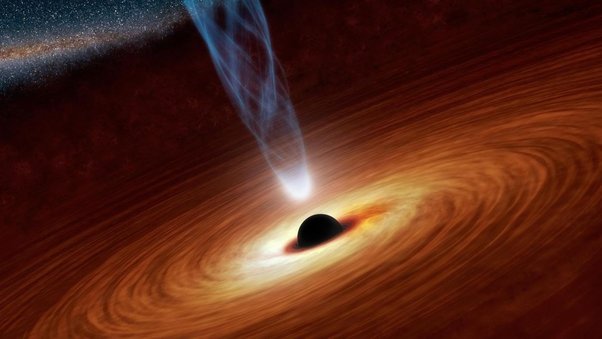
We just discovered that the supermassive black hole in the center of our Milky Way Galaxy spins near the maximum possible spin a supermassive black hole of this size can have.
Black holes cannot rotate at any speed, but there is a maximum, which depends on the mass of the black hole. Less massive ones can spin faster, and the one called Sagittarius A, which is near the center of our Milky Way Galaxy, has a mass of 4.3 million Suns.
When black holes rotate, they drag space time itself near their event horizon, and this dragging would exceed the speed of light if there were no maximum. However, it doesn’t mean that there is a physical surface being dragged. Instead, nothing can remain stationary with respect to distant objects, such as stars.
We are pretty lucky on Earth at the moment. Our system is in such a position now, on its 230 million long orbit around the Milky Way Galaxy, that it happens to be at the point where Sagittarius A’s spin axis is pointing towards us. We can detect its pole with our instruments, and we have just discovered that this monster supermassive black hole is spinning near its maximum possible theoretical limit of rotation.
This is not the only surprise from this study. It turns out that the emissions, which we detect from Sagittarius A, are not from its jet, but from very hot electrons in the accretion disk.
Since this supermassive black hole’s axis of rotation points towards us at the moment, the jet should also point in the same direction, and it was thought that this was the source of emissions.