Jacob Fox is completely correct.
The Hubble Space Telescope is not capable of taking pictures of the Apollo landing sites for 2 reasons:
- It does not have (anywhere near) the resolution to do so (at its distance from the Moon, the smallest details it can resolve are 600 ft. in diameter)
- The lit side of the Moon’s surface is generally too bright for Hubble’s sensitive cameras (Hubble can occasionally capture images in the shadowed transition region between the light and dark sides, and can capture images of the unilluminated surface)
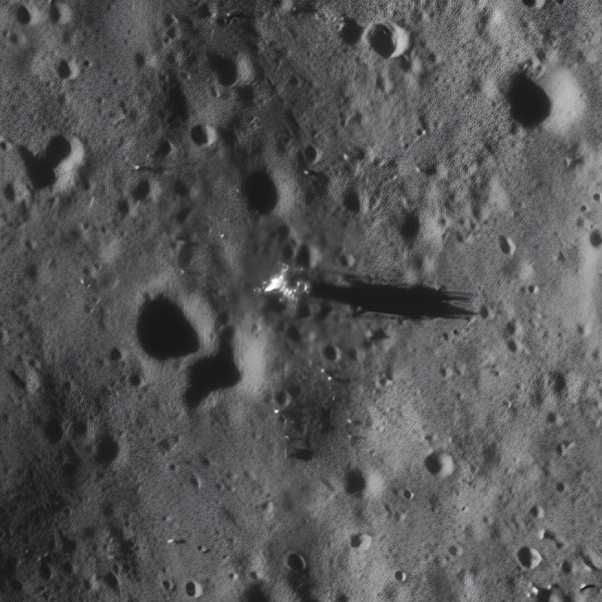
As several others have written, lunar orbiters from several nations have captured images of the landing sites. Here is a nice picture of the Apollo 11 site from India’s Chadrayaan-2 orbiter:
And here’s the best picture I can find of a rover that was left behind.
The picture is of the Apollo 17 landing site, taken by the Lunar Reconnaissance Orbiter. The Rover is to the far right, labeled LRV:
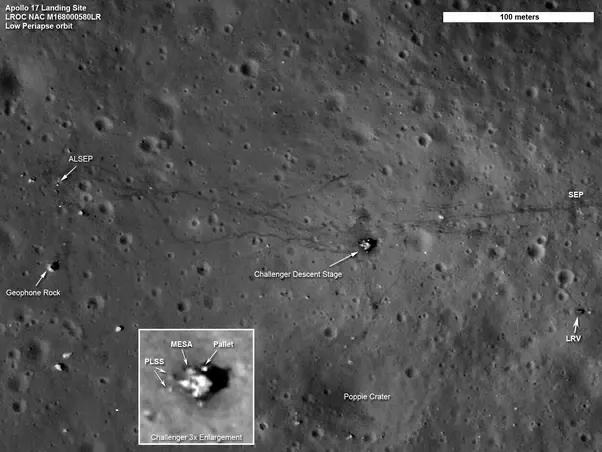
The rover tracks are clearly visible to both ALSEP and SEP.
Let me tell you a nice story: shortly after NASA has landed people on the Moon, the Soviets have sent two unmanned rovers there: Lunokhod 1 in 1970 and Lunokhod 2 in 1973. This is what they looked like:
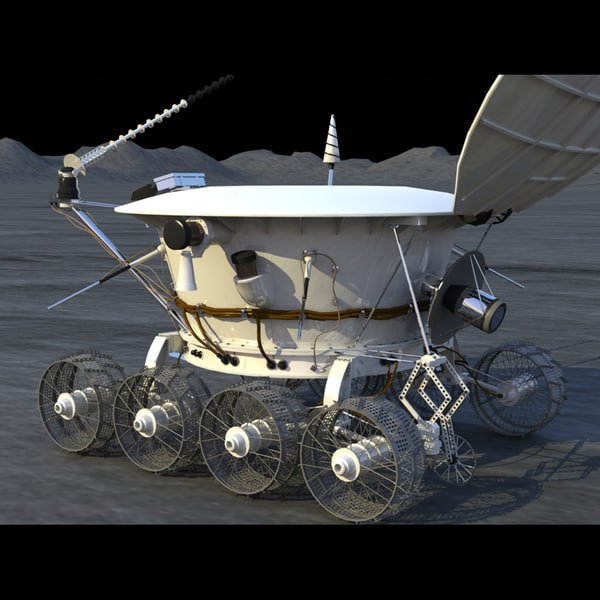
According to official data from the Soviet space agency, Lunokhod 1 travelled over 10 km and Lunokhod 2 almost 37 km on the Moon surface. They measured the distance travelled counting revolutions of an “extra wheel” dragged behind the rover (seen in the picture above). At that time there were no telescopes capable of seeing the rovers directly, so it was best measurement they had.
In 2013 high resolution photos of the Moon surface from the NASA LRO satellite were available. The resolution of those photos was good enough not only to locate the Luna 21 lander and the Lunokhod rover, but to see the actual wheel tracks and re-measure the distance travelled. This led to revising the distance upwards, to over 39 km, apparently the extra wheel was slipping occasionally and thus the original distance measurement was imprecise.
So, while as others said, the HST does not have sufficient resolution to see from the distance of Low Earth Orbit the actual rovers, we now have a telescope on the Lunar orbit, that has photographed the whole Moon and found all the landing sites and hardware left on the surface.