The USS America is the only super carrier ever sunk, either on purpose or in combat. It took four weeks and they ended up having to scuttle her from on board due to her not sinking. She is not only far larger than WWII battleships, but she is also a lot tougher. While she does not have the heavy armor the battleships of yore had, she does have a double (or maybe triple?) layered hull, meaning weapons have to push through alternating layers of steel and empty pockets to reach her internals.
On top of that, her internal compartmentalization was far better than that of battleships. She is so large, there are so many more rooms that must be filled in order to make her sink than that of a battleship.
Additionally, thanks to modern technology, most bombs, torpedoes and missiles actually have smaller warheads than what they used against WWII vessels. And in the process of the tests, they were actually using controlled explosives, not actual weapons.
The whole point of the tests was to make future carriers more survivable, as well as see how warships reacted to underwater explosion and damage. Clearly, after taking a beating for four weeks, they can survive a LOT due to just their sheer bulk. But at the same time, the tests were not meant to truly sink her immediately. Thus, there was no “shoot to kill” mindset of the naval officers conducting the test, versus the whole point of attacking enemy battleships was to sink them.
There you go. America lasted so much longer because a) they were not trying to sink her immediately (though they did end up having to board her to make her sink) and b) her sheer bulk made it a lot harder to sink by being able to absorb damage better than battleships.
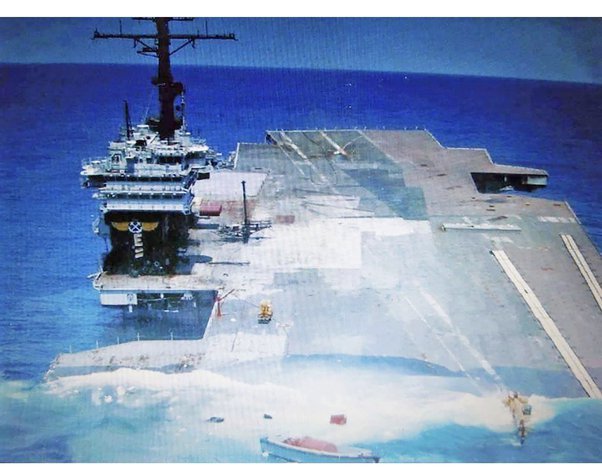
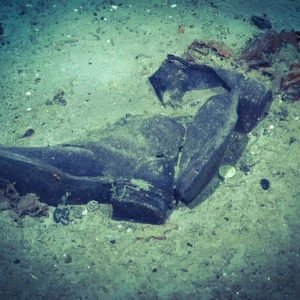
(The only known declassified photo of America’s sinking)
Something I forgot to mention. Almost all the warships outside of destroyers that were sunk in WWII were built BEFORE the war. We never lost an Essex class carrier, nor a Iowa class battleship. Problem with the older vessels was that they were meant to combat armor piercing shells and long range guns fired in low arcs.
So their sides and vital parts were plated in thick steel, leaving their topsides weaker and vulnerable to bombs and torpedoes dropped from above from aircraft. The Yamato and Musashi, the largest vessels sunk by aircraft in combat, each weighed over 70,000 tons and took over 19 torpedoes and 17 bombs before Musashi sank and 11 torpedoes and 6 bombs for Yamato. Still impressive durability.
EDIT 2: So many people are asking me about why they did not scrap the America. This is a tough thing to answer, simply because I do not know exactly what the higher ups of the Navy at the time were thinking, but I will give it my best guess.
Basically, to scrap the America, we would have to pay a scrapper between $5 and $10 million dollars. And it would take multiple years to do. (That is what I have read about other carriers of this size being worth).
Given the fact the America was built for about $200-$300 million, and it would cost another couple million to have it scrapped, the Navy decided that it would be the best candidate for these live fire tests.
Economically, it was the smallest loss to the original cost ratio versus any of the Nimitz class, or even it’s sister ships of the Kitty Hawk class (she was the only one not to receive the $400-$800 million upgrade the other three ships received). It was conventionally powered, meaning they did not have to worry about the nuclear radiation of a Nimitz class.
It was of similar size and design to the Nimitz so they could learn just as much as they would from sinking one of those in preparation for the Ford class. There were no plans for using her as a potential reactivation ship (one that could come back to service) or as a museum, as she was in very bad condition in comparison to her sisters.
It resulted that the potential benefits far outweighed the loss, as the lessons learned from sinking her would allow the Navy to perfect the Gerald R. Ford class, which was under development. It was just a logical decision in allowing the vessel to serve in one last capacity, without having to pay for tearing her apart or letting her sit as a museum. And hopefully, it worked (all data is classified, so I imagine it probably was successful).