Yes.
The hard dolomite cap of the Niagara Escarpment pretty much acts as a natural dam to contain Lake Erie. Its surrounded by those rock formations on all sides, and it pretty much exists because previous glaciations dug a hole in the dolomite that a lake can sit in.
Now, Lake Ontario used to be much deeper than it is now. If you come to Toronto, you can see where the lakeshore used to be – next to what’s now Davenport Road where there’s a steep escarpment. That’s because the lake was dammed by a glacier near what’s now Kingston, Ontario. Lake Ontario used to drain south into the Hudson River valley and out by New York City.
However, when the ice dam burst, pretty much all the water in Lake Ontario formed the St. Lawrence River and the water level dropped quickly – even past its present level. Lake Ontario now drains through that valley.
And, at some point in the future, the rock layer that forms the current Niagara River will erode all the way back to Buffalo where it will meet the soft sediment of Lake Erie. This already happened once in history right here.
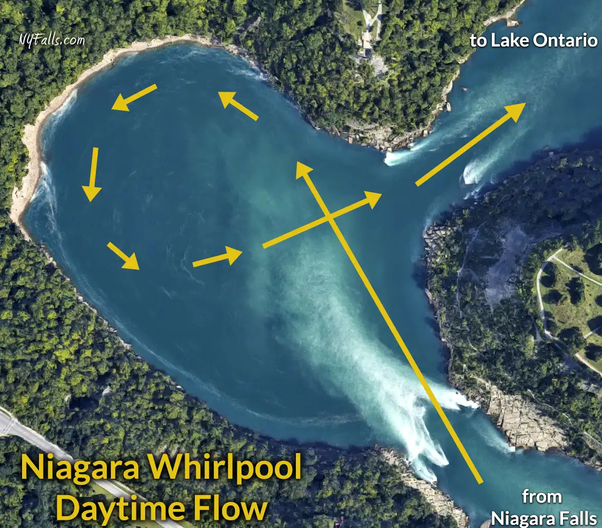
This is the Niagara Whirlpool. It too was once a big hole in the hard Dolomite rock, filled with water and sediment. For over a thousand years it was filled with water that flowed into the nearby Niagara Falls, north of the Whirlpool’s current location. Then all the dolomite fell away and the entire Whirlpool emptied in a single day as a new falls set up where the dolomite continued further south.
So, eventually, without the rock restricting the flow, the water from Lake Erie will essentially form a tsunami down the entire Niagara Gorge. The water level of lake will collapse rapidly and since the bottom of Lake Erie is higher than the top of Lake Ontario, all the water in Lake Erie will disappear into Lake Ontario leaving a series of rapids where the lake used to be.
The good news is that natural erosion of the gorge is slow due to water used for electricity production and it only moves back a fraction of an inch a year. It’s more likely a new ice age will cover the lake than it will erode back to the lake. In any event, it won’t happen for thousands of years even if erosion rises to historic levels.