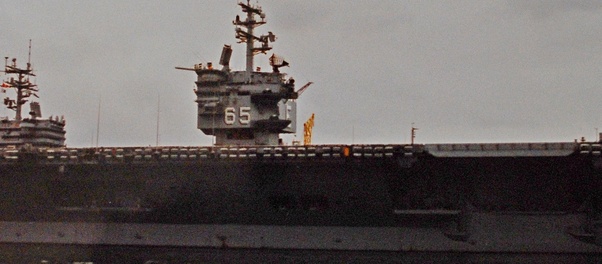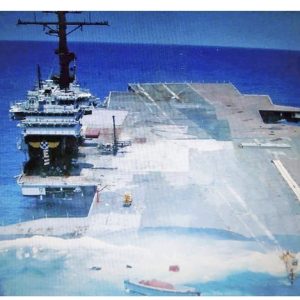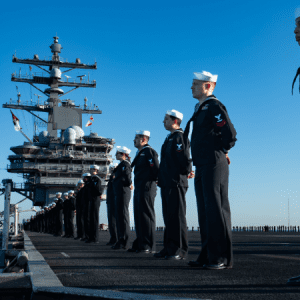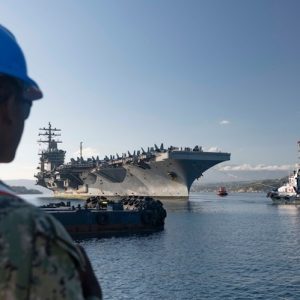
I served aboard two carriers on their last deployments, Enterprise being one of them, and those boats were worn out and past ready to be put to pasture. Enterprise was not “up to date” by the time she was decommed. And their robustness and cost is the reason they’re kept around as long as they are. Sailing thousands of miles of saltwater while flinging planes off the roof is a hard life. Fifty years – programmed life of a CVN – is a long time to be in such service.
Some components simply can’t be replaced, while others it would be cost-prohibitive and inefficient. The electrical system, for example; the power requirements changed between the start of Big E’s construction in 1958 and her final cruise in a 2012, on a scale never imagined by her original builders. It doesn’t matter how much power you’re generating if the electrical distribution system can’t handle the increased load.
As a ship ages it becomes increasingly difficult to locate spare parts, as manufacturers go out of business or simply stop supporting their very old, defunct product lines. Enterprise had an elevator, for example, for the aircrew to make their way from the ready rooms below the hangar deck up to the flight deck.
Sounds extravagant, but you try routinely climbing six floors’ worth of very steep stairs lugging 40 lbs of flight gear. Which is what the crews wound up doing anyway, because the elevator was always broken. The manufacturer had gone out of business decades before and it was imposible to find spare parts.
Incidentally, all subsequent US carrier designs put the squadron ready rooms on the O3 level directly beneath the flight deck for that reason.
Simply put, nothing lasts forever, even nuclear powered aircraft carriers.
’ve noted many answers that the USS Enterprise (CVN-65) was old and worn out when decommissioned … after all she was 60 years old. While completely true, I haven’t seen a comment about the huge RCOH (Refueling Complex Overhaul) executed at Newport News Shipbuilding from 1990–1994.
This was in essence a SLEP (Service Life Extension Program) for a nuclear carrier … restored what could be restored to almost new condition and updated almost every system onboard.
As can be imagined, this was no trivial expense. While I was with SupShip (Supervisor of Shipbuilding), I worked on the Enterprise before the RCOH. And, at that time as I recall, estimates were that this RCOH was going to cost something approaching $3B in 1990 dollars.
The ship that came out of the RCOH was obviously far more modern and combat capable than the ship that went in … all systems as up to date as possible without building a completely new ship.
However, this does not belie the fact that Enterprise was a one of a kind with 8 nuclear reactors instead of the two much larger ones on Nimitz class carriers, far more expensive to operate. Before the RCOH, there was much debate in the 1980s as to the wisdom of spending $3B on an old carrier.
Was this expenditure a good investment, or should the funds go to the construction of a new carrier. The Navy decided in the end to proceed with the RCOH and got another 20 years out of the Enterprise. Whether this was money well spent I leave to the reader to decide.
The decision to decommission a ship is always a balance between the “needs of the Navy” versus the funding available or anticipated. It’s done with careful analysis and is never a simple decision. Sometimes the Navy gets the decision right. Sometimes it doesn’t.
USS Enterprise (CVN-65) at Norfolk NS, 1990, prior to entering Newport News Shipbuilding for her RCOH.