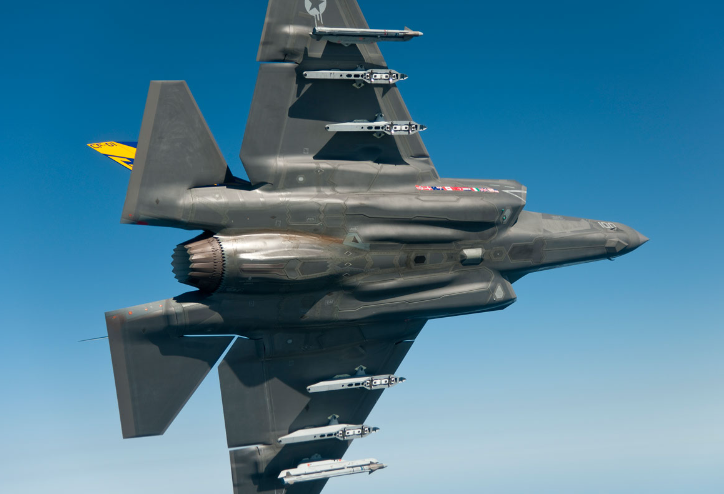
F-35C aircraft ARE able to be launched from and recovered by the USS Ford. The problem is that when the Ford class of carriers was designed, the operational requirements of F-35C aircraft were not taken into account. The requirements in question have to do with the capability to support and maintain those aircraft.
It makes absolutely no sense to station an aircraft aboard a carrier that can’t repair it when it needs to be fixed and/or supply it with the things it needs to carry out its operational missions.
Basically, the Navy dropped the ball in the design process. The next ship in the class, the John F. Kennedy, is still under construction and is being modified to support F-35C’s. Ford is scheduled to undergo an overhaul in 2025 to receive the required modifications as well.
Ford isn’t equipped for F-35’s right now because it wasn’t intended to be for several, very good reasons.
A carrier must not just have the parts stores for a new aircraft but its Aircraft Intermediate Maintenance Department (AIMD) must also be equipped with specialized test benches, test stands, and equipment and the maintainers trained to maintain them.
In the F-35’s case you also have to consider the new equipment necessary to maintain and repair its specialized low-observable airframe. Ford’s AIMD equipment was frozen before the F-35 support requirements were finalized and the specialized support equipment built so it was equipped to support F-18s.
Right now it is deployed in the Eastern Mediterranean fully equipped with three F/A-18E squadrons, one F/A-18F squadron and one EA-18G Growler squadron.
It’s important to understand that new aircraft don’t magically arrive en mass to the fleet ready to go. After development and testing the airframes have to be built and squadrons trained and equipped so new aircraft are phased in over time and this is synchronized with the conversion of the CVN AIMDs.
There is absolutely no reason to convert every single carrier (even a brand new one) to support the new aircraft when there aren’t enough aircraft or trained squadrons to fill them. Also, conversion usually means that some equipment intended to support legacy aircraft must be removed making it incapable of supporting those aircraft.
Right now there are only two operational F-35C squadrons and, as you would expect, two CVN (Vinson and Lincoln) fully capable of supporting them. More CVN will be converted during yard periods as more F-35 squadrons come on line. Ford is scheduled for conversion during its next big yard period in 2026.
This is exactly the same thing that was done when the F-14 replaced the F-4. It’s not like they just pushed the F-4’s over the side on Monday and landed 600 F-14’s on the decks on Tuesday. We had carriers still flying (and maintaining) F-4’s until 1987, that’s years after the first F-14’s arrived in the fleet. The same thing happened when the F/A-18 replaced the A-7.
So, this is completely normal and not a mistake or oversight as some seem to assume.