Dirty and bug-infested by what standards?
The Romans built over 200 aqueducts, 11 in Rome alone, one of which still works and supplies the fountains in Rome (but not the drinking water because, you know, by today’s standards it’s dirty and bug infested.)
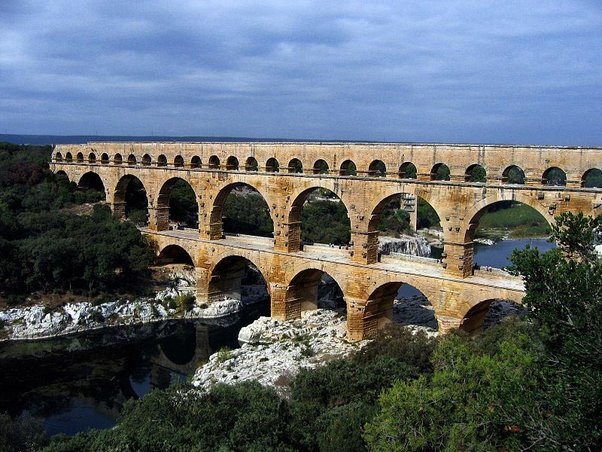
Roman aqueducts were marvels of engineering.
The Romans had to bring water from the mountains and when it traveled underground through tunnels, it built up dirt and cinter or calcium on the pipes. Slaves had to be used constantly in the dark in water up to their knees – or worse – with buckets and shovels to move the dirt out of the tunnels to keep the water flowing. The Romans cleared the water of silt through stepped settling tanks. The water passed through limestone filters that removed sticks and bugs and also gave the water pleasant taste and some amount of “fizz”.
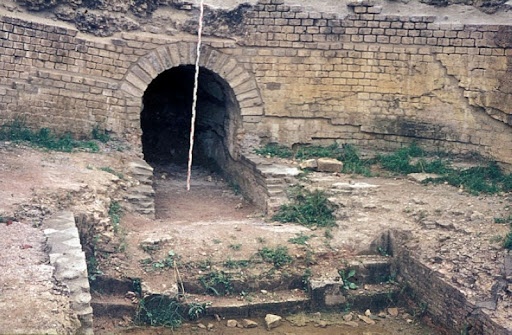
The water that was brought into town was put through a series of settling tanks to allow sand and silt to settle out, requiring constant work by slaves to dig out the pits. When the Roman empire failed, the aqueducts failed because there was no one left to maintain the pipes and clear out the cinter and silt.
In order to operate, the aqueducts had to slope downhill. For the most part, the Roman engineers were so skilled – using tools we no longer know about – to create slopes as small as 1/4 of an inch to prevent too rapid flow of water overfilling the aqueducts. Aqueducts were built exclusively by the Roman Army because their importance could not be trusted to slaves.
The cement used was mixed with sheep blood to prevent it from cracking in the frost. Sometimes and engineer would make a wrong calculation and when the aqueduct was complete it ran uphill instead of downhill. When that happened, the Army would hang the engineer from the highest arch – and after he fell apart from the gibbet, they would knock it down and a new engineer would start again.
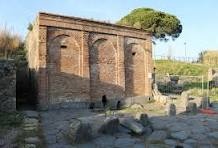
Castletums were large building that held water at the end of the aqueducts. The height of the building created water pressure for the fountains. A series of pipes came out from the bottom leading to various fountains which were turned on twice a day to provide water for people who lined up with amphora and buckets to get water for the day.
Sometimes the Romans would run out of money in the middle of the project so they would build a steeply sloped ramp to speed up the water and cause it by force of gravity to fly up the next hill where another aqueduct would continue when they had the money.
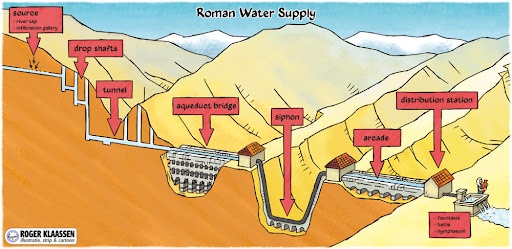
The Romans were incredible engineers and the water system was maintained by the Army since the Romans considered it so important.
When the water got to its destination, it would fill a massive tank called a “casteltum” where the weight of the water would create hydraulic pressure to power the fountains through clap pipes and fill the baths. Contrary to popular belief, the baths were highly contaminated by germs and bacteria. People came to get clean but got a nice dose of bacteria instead. Apparently they got used to it and didn’t end up sick from it often.
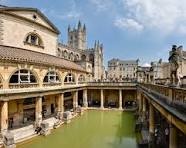
The Romans loved their baths and they were quite advanced with hypocausts for hot water and multiple pools and even showers. But they were filthy places.
The Romans also invented a kind of water pipe made of lead. Since theypioneeded didn’t know about pipe extrusion they would bend sheet lead over a rod of iron and then make a fire on top to cause the pipe to weld itself together at the seam. Rich Romans could have water piped right to their homes. They even had bronze ball valves not so different from what we use today.
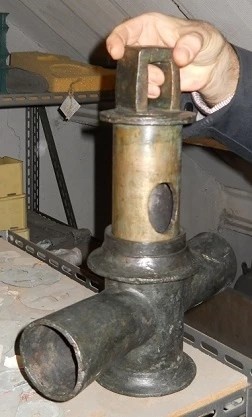
Roman water valves and diverters were miracles of craftsmanship that still work today 2000 years later.
Romans also pioneered the sewer, the Cloaca Maxima, of which they were very proud. There were many, many miles of underground tunnels that still work today. Water and rubbish was flushed away right into the Tiber. Roman homes had bathrooms right inside the front door, always on the left side of the entry and covered by blankets and hides to prevent the smell of the sewer from entering the house.
The Romans cut a hole into a concrete box that dropped directly into the sewer so the smell and gases came right into the house. It was always on the left near the door, the farthest room away from the living areas in the house and always on the left because the Romans, being superstitious, always associated the left with “bad” and bodily waste was always bad.
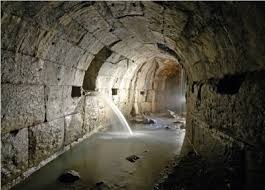
The Cloaca Maxima was a source of great pride to the Romans and even had its own God.
The chief engineer of the waterworks was called the Aquarius and he had massive power and authority. Many people would dig up the lead pipes at night and engage in “midnight plumbing” to get water to their own homes. The pipes were buried only about a foot below ground because there were so many problems they always had to be dug up and fixed. People pirating water from their nocturnal plumbing caused pressure drops throughout the system and special extremely draconian laws had to be passed to punish water thieves.
The movement of water and removal of sewage was one of the greatest things ever invented by the Romans. We still use the concept of “casteltums” today – when you see water tanks on long stilts or the roofs of buildings. The Romans discovered that for every foot water was raised, you got a half a pound of water pressure. We still use that concept today.
None of the other answers I’ve read actually explains how Roman aqueducts delivered relatively clear water. Yes, it was not necessarily germ free, but the addition of wine, vinegar, or myrrh pretty well took care of that problem.
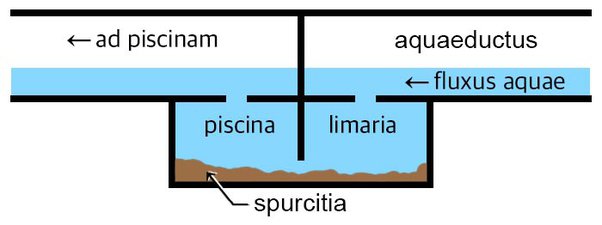
The remaining problem was one of turbidity: stuff in the water. That “stuff” could, and did, include leaves, insects, silt, fecal matter, the bodies of small animals, and more. This crud was mostly removed from the water by a construction known as a piscina limaria (literally “slimy basin”), in which the crud would mostly settle to the bottom as the water carried it through. These settling basins were built in many different ways, depending on the shapes of the spaces in which they were put, but they were always located as near to the end of an aqueduct as could reasonably be worked out. Here is a schematic drawing that illustrates the principle on which they worked.
Terms:
ad piscinam = to the reservoir
aquaeductus = aqueduct
fluxus aquae = flow of water
piscina limaria = settling basin
spurcitia = filth
The “reservoir” would generally be a piscina (storage basin, or pool) or a castellum divisorium (distribution basin).
There was a drain opening in the piscina limaria, and part of the job of the aquarius (aqueduct manager) was to see that the crud was flushed out frequently enough that the flow was not impeded.