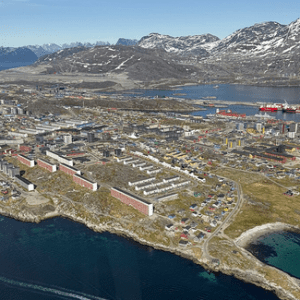
The US military is tasked with keeping three carriers deployed at all times, usually with one in the Atlantic, one Pacific and one Middle East-ish. Believe it or not, that requires 11–12 carriers in the fleet. No ship or crew can remain deployed indefinitely. Six months at a time is a typical deployment, and I can tell you that at the end of six months, the ship, planes and crew are pretty beat up.
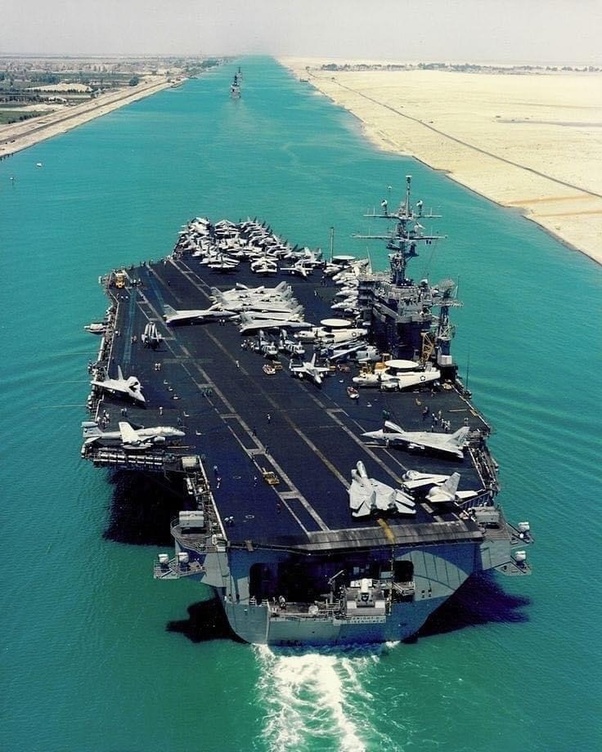
We were at five months’ deployed when we were called upon for Desert Shield. I was one of those people on deck gawking at the Suez Canal.
Carrier battle groups are essentially on a three-part rotation: one deployed, one on stand-down recovering from deployment and conducting long-deferred maintenance, and one on workups preparing to deploy. The one on workups is also on standby in case it’s needed, and can deploy relatively quickly. OK – so what about the other ones, numbers 10,11, 12? Well, ships like these require overhaul every 10 years or so, updating systems and refueling the reactors.
This takes years, since these are REALLY big, complex ships that take a beating when they’re out doing their thing. The Ford class might do a little better on the refuelings, since they’re only going to need it once in their 50 year lifespan. There are also tertiary duties to which a carrier might be assigned, like performing carrier qualifications for new naval aviators.
So that’s why the need for so many carriers: because they can’t “just” stay out on deployment all the time. Even if the ships could do it, the crews couldn’t.
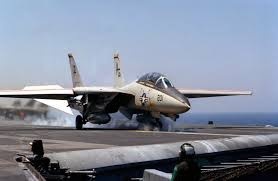
I wanted everyone and everything involved in this to be on point, when they were launching and recovering me.
Edit: I tried to answer this from a very narrow perspective, to illustrate the not-at-all-obvious fact that in order to keep one ship on station all the time, requires 3–4 ships in the fleet. That’s all. I think there is a misconception that 11 carriers in the fleet means 11 carriers at sea all the time, so I wanted to explain the real world rotation, and the reasons behind it.
The US Navy is tasked with doing X; in order to do that, it requires Y resources. What I (intentionally) did not address is whether that tasking is appropriate, necessary, moral, etc…, and I’m deleting comments that drag the discussion down that rabbit hole. That’s not “censorship,” it’s keeping the discussion on track.
Let me be clear: if you want to write a diatribe about that tasking, either pro or con, that is your right. But write your own damn answer, and I promise not to sidetrack your conversation with real-world rotation minutiae.
Also, in response to those juvenile “All u need to do is just this, and those tin cans are sunk lol” comments that I deleted, my equivalently snarky response is “OMG – No ever thought of that! You must be the smartest person in your mother’s basement!”
It should be noted that a “nuclear” vessel usually means nuclear-powered, not armed with nuclear weapons. Some nuclear vessels do carry nuclear weapons (though no aircraft carriers that I know of) but I would be very skeptical of anyone who claims to know exactly how many.
Nuclear power is a very good energy source for large sea vessels. They’re expensive to build but they can go for a much longer time before needing to be refueled, and they pollute a lot less than a diesel engine. We would make the whole fleet nuclear if we could.