Terribly behind-old technology. Designed in the 1960’s, so few computers.
Going supersonic, while not easy, is not that hard. Doing so economically is REAL tough. The cost of fuel alone was roughly 3.5 times that of a conventional jet. Same fuel, it’s just supersonic travel burns it up fast!
Here is a picture of the cockpit of a Concorde-it’s easy to identify a concorde cockpit, the yoke has a fairly unique design.
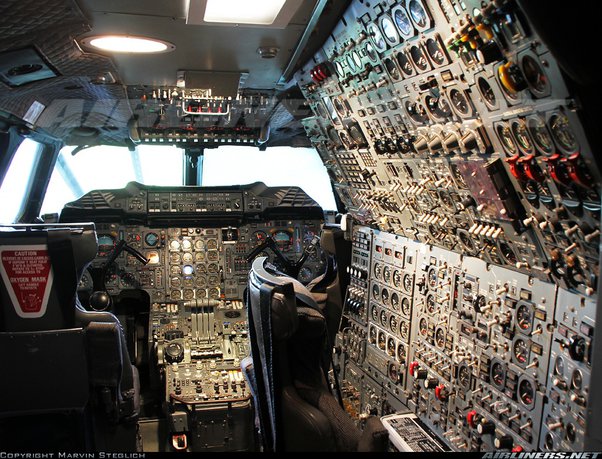
The busiest person on a Concorde was the flight engineer (part of his console is at the right-he had about double the number of controls, dials, and switches as did the two pilots combined). Instead of using trim tabs to balance the aircraft (they create a little drag, which was unacceptable on a Concorde), the Concorde flight engineer constantly pumped fuel back and forth from one of 17 fuel tanks to another to keep the plane level.
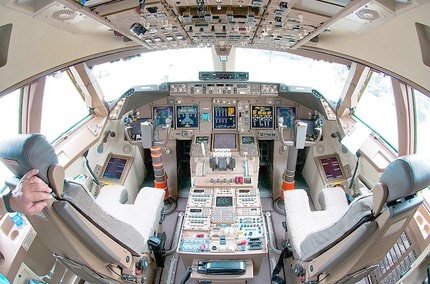
By comparison, here is a cockpit photo of Boeing 747–8 cockpit. The aircraft has a 2-man crew. and look how much simpler the cockpit is.
There are two points that make the Concorde as advanced (or more) than modern airplanes:
- She was the first fly-by-wire airliner. On the Boeing 737 MAX, for example, only the spoilers are fly-by-wire.
- Concorde was a supersonic airliner. There are no supersonic modern commercial airplanes flying today.
Not bad for an aircraft designed in the 1960’s. But not enough:
To be as advanced as modern airliners, the Concorde begs for an upgrade of avionics, systems, engines and materials.
The above would make a new Concorde (-800?) a real badass…
And more fuel efficient than its predecessor. But not enough to make it commercially acceptable.
Concorde is still advanced comparatively, because no other aircraft has ever matched its overall performance. It could supercruise (fly supersonically without afterburner) for 3+ hours at 60,000′ while carrying 100 passengers in comfort.
The aerodynamics have yet to be bettered which is amazing when you think it was done with slide rules.
The engines and intake/exhaust systems were computer controlled, were extremely sophisticated and the intakes and exhausts produced 60% of the thrust at Mach 2.0 with the engine core producing the rest.
The flight controls were fly-by-wire (analogue) and the Olympus 593 was the most thermally efficient turbojet ever produced. Its SFC compares favourably to modern engines.
As long as the technology is able to perform its function effectively and as designed, it is a mistake to call it ‘out of date’ just because newer ‘sexier kit’ exists. Aircraft are work tools not smart phones. If new technology does not offer a significant advantage over existing, then it is often more cost smart to retain it rather than expending on new equipment that will not bring many real advantages,
There are 747–300s and 200s, DC-10s and other aircraft still operating profitably with cockpit and other technology comparable to Concorde. In fact none of these aircraft are fly-by-wire so Concorde is one up on them.
The fact that BA was able to operate the aircraft profitably for over 20 years speaks to its efficiency. To this day, it is the most efficient supersonic, supercruising aircraft military or civilian ever built.
There is much talk these days about Boom’s Overture being able to fly at Mach 1.7 carrying 25% fewer passengers at a lower altitude. I’m not sure… Overture has just undergone a complete redesign that makes it almost a twin to the failed Boeing 2707–300 design. The XB-1 testbed aircraft is 2 years late and at time of writing (Sep22) has not flown yet and when it does, there are questions as to what valid data it will be able to give as it is a scaled version of the old design not the new one.
They don’t have an engine at all, much less than one that can supercruise. So far, it is artwork and PR and not much more. This makes Concorde, designed in the mid-sixties even more astonishing.
Below are some shots from my 1999 flight plus some others.
The view is one that since 2003 has been unavailable to normal humans. I hope we will once again be able to experience supersonic flight but we will see.