See this?
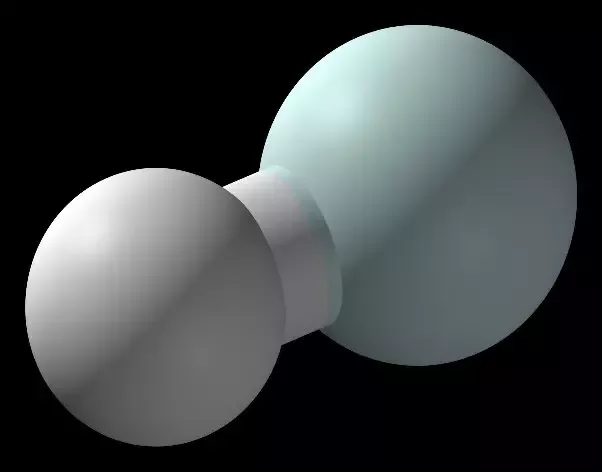
This is a helium hydride ion (HeH+). It is technically* the strongest acid in existence.
Now you may be thinking something along the lines of: “Wait a minute, I thought helium was a noble gas and so didn’t bond with anything!”
I hate to tell you this but what you learnt in school was wrong.
Helium hydride is formed in the decay of tritium and many believe that it is found in the interstellar medium (the matter that is found between star systems in galaxies), although, none has been observed there.
It is also possible that it was the first compound in the universe because when the universe became cool enough for ions to form, only hydrogen and helium (and a little lithium) were present. These ions of helium hydride would later cause the formation of the first stars.
So how is it the strongest acid in existence?
To find the acidity of helium hydride, the proton affinity test is used, this measures the amount of energy released when the substance reacts with a proton. The lower the amount of energy released, the stronger the acid.
Helium has the lowest known proton affinity and therefore helium hydride is the strongest known acid. It is in fact so reactive that it can not actually be measured with the normal pH scale.
Helium hydride still remains a bit of a mystery to scientists. It is tough to spot via spectroscopy and should be seen easily given that current models suggest that there should be lots of it. The other compounds suggested by the models have been found so why not helium hydride? Maybe it isn’t quite as stable as we thought.
Because helium hydride is so integral to our understanding of how the first stars were formed, if it has different properties to what we think now it would cause us to have to rewrite our ideas of how the first stars and galaxies appeared.
As I said in another scientific answer, if anything is wrong, please tell me and I will correct it.