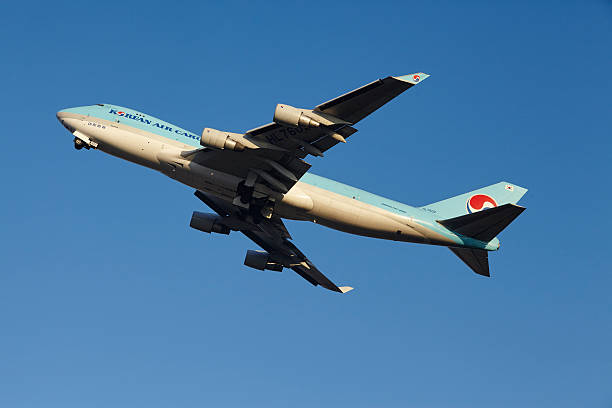
Apparently, a lot of pilots are not aware of the origin of this practice. This was not done until the 747 was introduced. Prior to the 747, when takeoff power was applied, the throttles were moved from idle to takeoff power with no hesitation midway. But the 747 presented a problem. With such huge engines, acceleration from idle power to takeoff power varied from engine to engine.
So, picture this. You taxi onto the runway. When cleared for takeoff, you push the throttles right up to the takeoff power position without hesitation. The number 1 and number 2 engines on the left side wing rev up to takeoff power right way, but number 3 and number 4 on the right wing lag behind.
There is now far more thrust on the left side than on the right side. Since the nose wheel on the 747 does not have much weight on it, it doesn’t have enough traction with the runway to counteract the thrust imbalance and keep the plane going straight ahead.
Pointing the nose the way you want it to go, is also the job of the rudder (vertical control surface at the rear of the plane), — but you have to have enough air flowing past it to get enough torque. So…
There just isn’t enough weight on the nose wheel, nor airflow across the rudder, to steer the plane, and the plane starts heading off the runway to the right.
The pilots quickly pull the throttles back to idle to try to stop the skid. But these engines are so huge, that it takes a few seconds for them to slow back down to idle. The plane continues skidding the nose wheel to the right and the plane goes off the runway into the grass.
After that happened a few times, 747 pilots were trained to “spin ’em up” and let all four engines stabilize at the same RPM, and then apply takeoff power. It was at the earliest part of the engines’ acceleration from idle that had the variation, so once the engines were well above idle, acceleration to takeoff thrust was consistent on all engines. Adds maybe 1–2 seconds to a flight segment.
Yet, enough pilots ignored the procedure that you will find a black arc going off the runway into the grass at most airports 747s fly out of.
To try to get everyone on-board with this procedure, some airlines trained pilots – regardless of what plane they were flying – to use the “spin ’em up” procedure so it would be a habit and they wouldn’t get into trouble if they ever ended up flying the 747.
So now, pilots at airlines that don’t have 747s don’t use the procedure, and airlines that have 747s train all pilots to use it.