Your question contains a giant error. There are no giant empty spaces left after pumping out the oil for decades. Unlike Carlsbad caverns, the pores containing oil in the reservoirs are, at best, maybe an inch across at the largest and most closer to an eighth or less at that. Go out on a cut bank along side the highway somewhere.
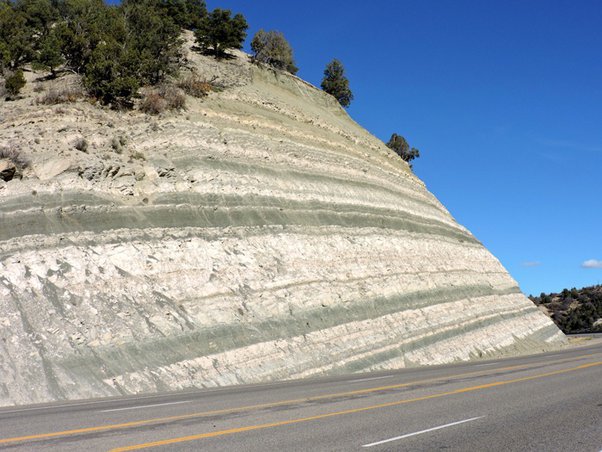
Examine the rock. Somewhere in there should be a porous formation if for no other reason than just weathering. At the same time the rock still holds it strength and shape. The term is well consolidated or crystallized according to the rock type. In either case the pores are empty so why hasn’t the wall collapsed?
Check out the definition of rock: a naturally occurring solid aggregate of minerals or mineraloids. Note the word ‘solid’. That means it will stand as a unit unless some superior force acts on it even with empty pores.
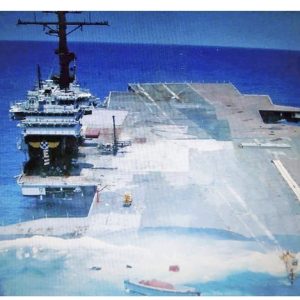
Now lets consider the North Sea; specifically the Ekofisk field. The reservoir is a high porosity chalk and has less vertical support than a normal sand or carbonate and it has experienced subsidence.
Surface subsidence was a major issue at Ekofisk. By 1984, the seabed had subsided approximately 10 ft, prompting a major project to jack up the offshore platforms. A major field study in 1992 concluded that using water-injection pressure maintenance to arrest the reservoir pressure decline could minimize future seabed subsidence. Voidage replacement was achieved in 1993. Additional laboratory studies found that water injection had induced shear in the chalk.
Shear failure and water-weakening of the rock matrix causes additional deformation of the chalk, even under conditions of constant or decreasing stress levels. Despite the use of voidage-replacement waterflooding, seabed subsidence continued until 1998, when the subsidence rates slowed dramatically because the water-weakening effect was expended and the reservoir pressure had increased.
I tried to keep the answer simple but it appears to have caused more confusion. Oil reservoirs have multiple drive mechanisms. Pressure from overburden, gas expansion, water drive from below are the primary types.
With any of these and a competent rock, the results are the same. Voids are left, sometimes filled with gas, pressure is reduced allowing encroachment by water from below – just the normal results of physics at work. The net result remains. No collapsing of the reservoir.
Oil or gas is not held in underground caves. It is found in the very small gaps between sand grains in a rock. A good analogy is a bathroom sponge: it is originally full of water. When you wring it out, it has no water in it, but the sponge continues to support itself. The porous rock of an oil field reservoir rock is exactly the same: the sand grains in the rock continue to support themselves after the oil or gas is produced.
I know of two exceptions: the Ekofisk field, where the reservoir is a very, very weak chalk, and this rock squeezes and shrinks, and drives the oil out as the reservoir pressure reduces due to oil production.
The other exception is the Gronigen gas field, onshore the Netherlands, which is an astoundingly large gas field that is exceptionally thick. So thick that the high pressure at the top of the reservoir is much higher than the pressure in the rock layer above it and this high pressure actually forces the sand grains of the reservoir rock apart. As the gas is produced, the pressure reduces and the rock “relaxes”, shrinking slightly.
In both cases, the shrinking of the reservoir rock is seen at the surface by subsidence: 15ft (I think, from memory) at Ekofisk, and up to about 4ft (again from memory) at Gronigen.