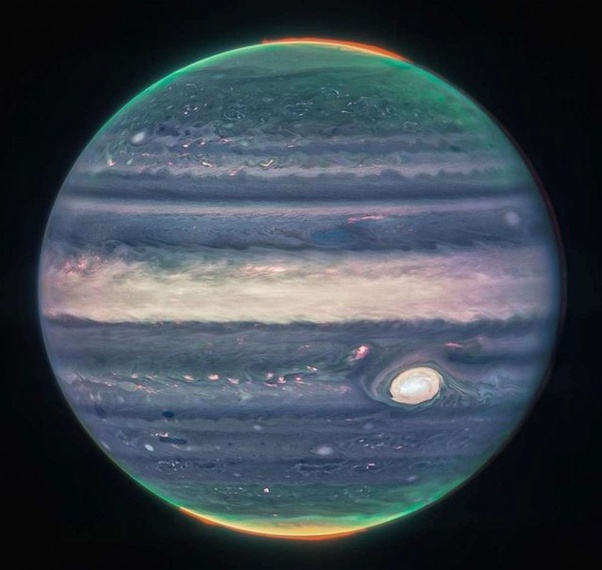
Jupiter, the largest planet in our solar system, is often referred to as a gas giant due to its composition, which is predominantly hydrogen and helium. Unlike Earth, which has a well-defined solid surface, Jupiter’s “surface” is quite a different story.
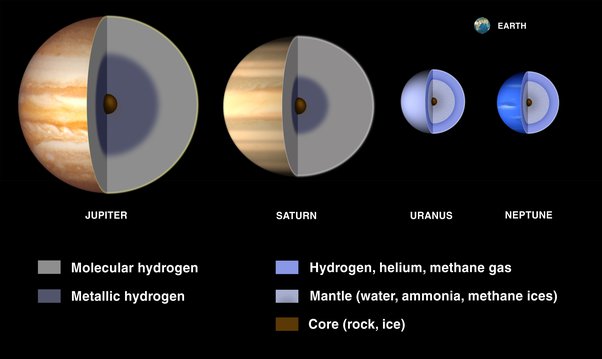
As we descend into Jupiter’s atmosphere, we would first encounter the outermost layer, consisting mainly of molecular hydrogen and helium, along with trace amounts of other gases like ammonia, methane, and water vapor. As we go deeper, the pressure and temperature increase, causing these gases to become thicker and more like a liquid.
At around 20% of the way towards Jupiter’s core, we would find a region where the hydrogen starts to behave more like a metallic fluid. Here, the immense pressure has forced the hydrogen electrons to move freely, creating a highly conductive state. This metallic hydrogen layer is believed to be responsible for Jupiter’s powerful magnetic field, which is about 20 times stronger than Earth’s.
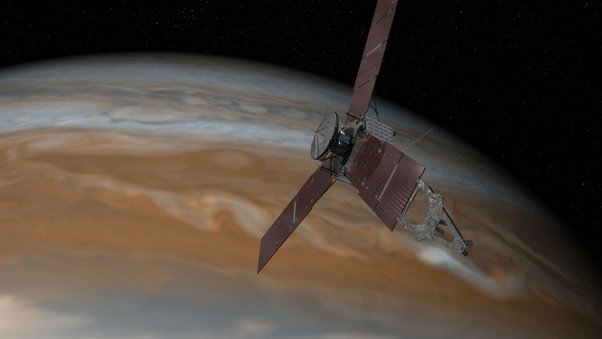
As we approach Jupiter’s core, things become more uncertain. Recent data from NASA’s Juno mission, which has been orbiting Jupiter since 2016, suggests that the planet may have a solid core. However, this core is not like the solid surfaces we find on Earth or other terrestrial planets. Instead, it’s thought to be a mixture of rock and ice, with a mass between 7 and 25 times that of Earth, surrounded by a layer of partially dissolved materials. The exact size, composition, and state of Jupiter’s core are still subjects of ongoing scientific investigation.
So, does Jupiter have a terrestrial surface like Earth? The short answer is no. Jupiter lacks a solid, well-defined surface on which one could stand or land a spacecraft. Instead, it is composed of vast layers of gas that transition into a liquid-like state and then into a metallic hydrogen layer as we venture deeper. The nature of Jupiter’s core remains somewhat mysterious, but it is not comparable to the solid surfaces we find on Earth or other rocky planets.
Unfortunately, no.
Jupiter is big. REALLY big. All of the planets of the solar system can easily fit inside Jupiter, with room to spare. It is the largest planet in our solar system, and it is made up of hydrogen and helium (mostly). This will be important later on.
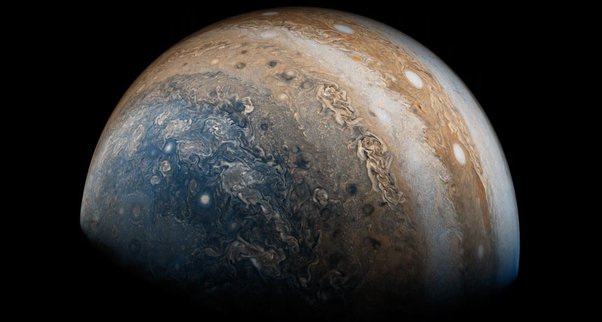
Jupiter, in all its beauty. Credit: JUNO/NASA/ Science News.
Because of the fact that Jupiter is so large, Jupiter also has a thick atmosphere. This is very important. On Earth, our atmosphere is right around 1 ATM of pressure. It is made up of gases that are not highly compact and 1 ATM of pressure is not that much.
That 1 ATM of pressure comes from over 100 kilometers of air above us. To replicate the effects, one only needs 33 feet of saltwater above them to feel the same pressure. Even though our atmosphere contains heavy nitrogen and argon, it does not have a strong pressure. This is because the gases are spread out. There is a lot of room between one molecule of gas and another molecule of gas.
There is not this much room between molecules of water. They are in a liquid state, so they are much denser than air. As you add more atmosphere above your head, the pressure increases. Now in the case of Jupiter. Its atmosphere extends over 5,000 km!
Its atmosphere causes immense pressure. This factor, combined with Jupiter’s strong gravity, increases the pressure tremendously. There are points on Jupiter where the pressure could be millions of atmospheres!
Now, I am going to answer your question. The immense pressures of Jupiter would have broken down any surface that was present in the formation of Jupiter. Some rocky material may be present according to new Juno probe findings, but it exists at unimaginable pressures. Nothing we could and have ever built could survive that. No landing on Jupiter :(. As you go deeper into Jupiter, the atmosphere transitions into a liquid. Most likely liquid hydrogen. But its properties are vastly different than that of normal liquid hydrogen. At a supposed core, a rare and theoretical compound may reside. Metallic hydrogen. Unlike anything we have ever seen. Crushed by pressures that are unimaginable for us, hydrogen atoms are arranged in the most efficient and dense combination known to man. It could even be used as rocket fuel!
Because of this, Jupiter has no surface.
The massive Jupiter, which is mostly made up of hydrogen and helium, is similar to a tiny star. Despite being the largest planet in the solar system, the gas giant lacks the mass required to elevate it to stellar status.
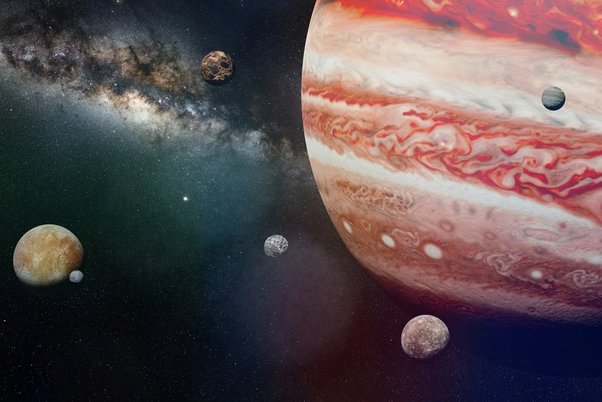
Jupiter’s Atmosphere
Scientists aren’t exaggerating when they refer to Jupiter as a gas giant. You would never find a firm landing if you parachuted into Jupiter in the hopes of hitting the ground. Jupiter’s atmosphere is composed of 90% hydrogen. The remaining 10% is almost entirely composed of helium, with minor traces of other gases present.
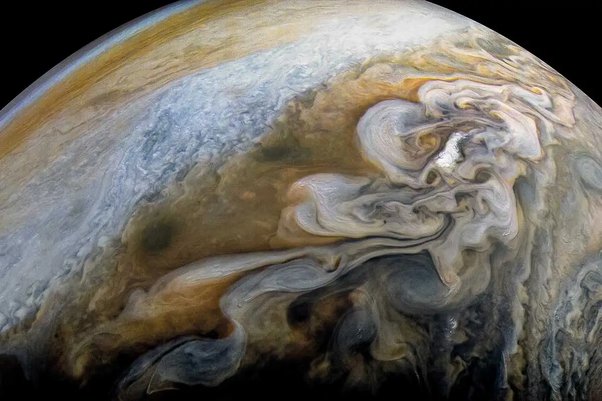
These gases build up on top of each other, forming layers that extend downward. Because there is no solid ground on Jupiter, the surface is defined as the point at which the atmospheric pressure equals that of Earth. At this point, gravity is nearly two and a half times stronger than it is on Earth.
It would be impossible to stand on that surface because it is simply another layer of gases. Spacecraft and astronauts would be lost in the muck. A probe or spacecraft traveling further into the planet’s core would encounter only thick clouds until it reached the core.
The core of Jupiter
Details about Jupiter’s core are still difficult to come by. The dense central core, according to scientists, may be surrounded by a layer of metallic hydrogen, with another layer of molecular hydrogen on top.
Scientists are unsure how solid Jupiter’s core might be. While some researchers believe the core is a hot molten ball of liquid, others believe it is a solid rock 14 to 18 times the mass of the Earth. The core temperature is estimated to be around 35,000 degrees Celsius (63,000 degrees Fahrenheit).
Jupiter’s core was not even discussed until the late 1990s, when gravitational measurements revealed that the gas giant’s core was anywhere from 12 to 45 times the mass of Earth. And just because it once had a core doesn’t mean it still does – new evidence suggests that the gas giant’s core is melting.
Not even a star
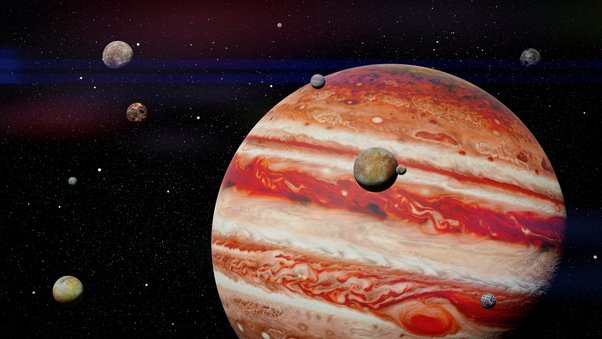
Jupiter, like the sun, is mostly made up of hydrogen and helium. However, unlike the sun, it lacks the necessary amount to initiate fusion, the process that powers stars. Jupiter would have to be 75 to 80 times more massive than it is now to be classified as a star. Even if all of the planets in the solar system formed as part of the gas giant, it would not have enough mass. Nonetheless, Jupiter is two and a half times larger than all of the other planets combined in the solar system.